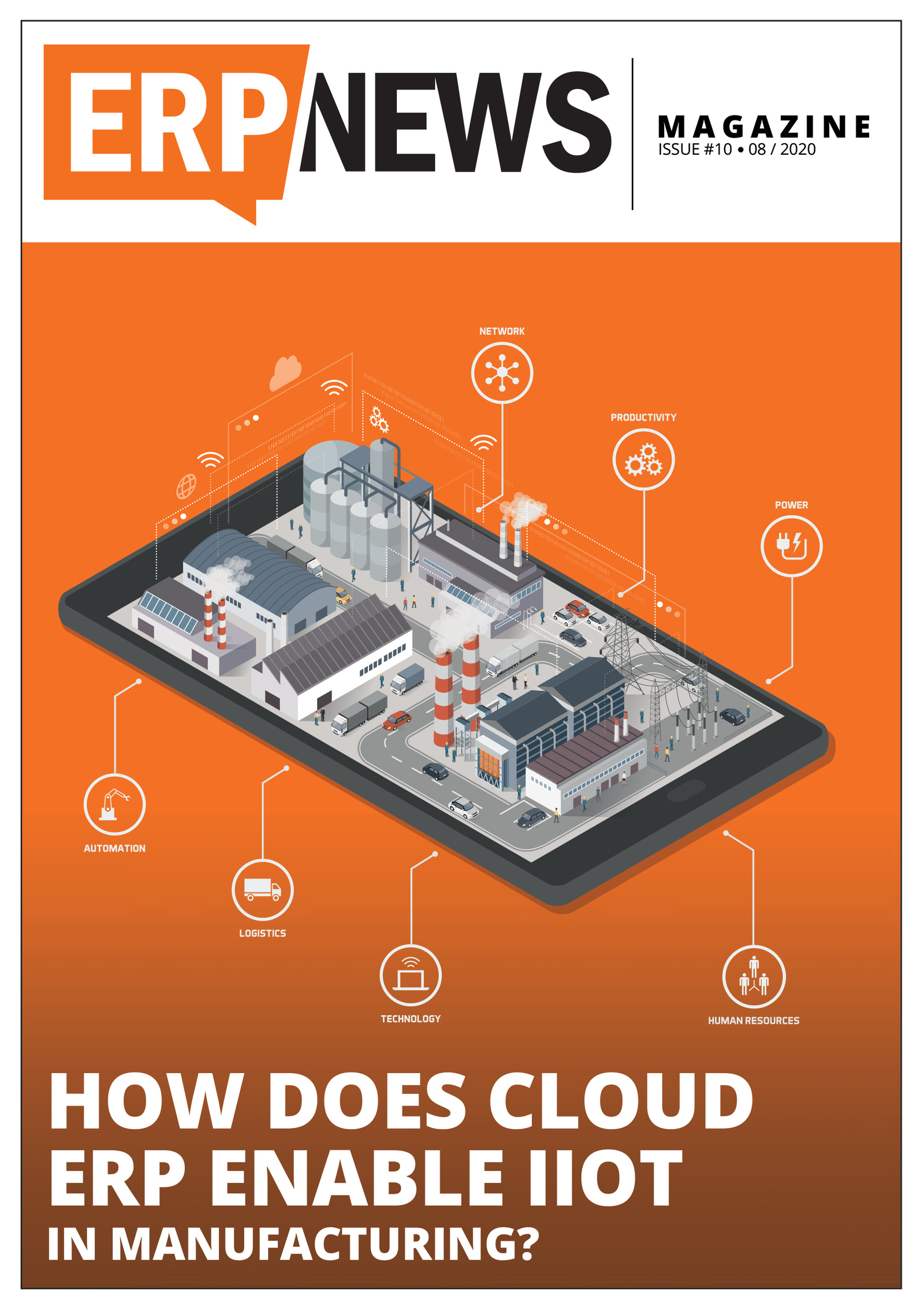
How Does Cloud ERP Enable IIoT in Manufacturing?
Connecting manufacturing data, cloud ERP and industrial devices, with perspectives on Industry 4.0, supply chains and integration architecture.
About this issue
Connecting Business Systems with Industrial Data
How can cloud ERP turn information from industrial devices into something useful for manufacturing decisions? ERP News Magazine Issue 10, dated August 2020, examines the relationship between IIoT, Industry 4.0 and enterprise systems. Its contributors connect machine data with planning, maintenance, inventory and customer service, while also considering the integration work and organizational choices required. The issue places operational visibility alongside the pandemic's disruption to production and supply chains.
Manufacturing Perspectives
Nicolas Morin, identified elsewhere in the issue as Nicholas Morin, Vice President of Professional Services at Genius Solutions, discusses the information manufacturers already hold in ERP and how it can support a broader digital strategy. His article links real-time operational data, analytics and process improvement with preparation for connected technologies. Its cited research figures are contextual claims, not newly measured Genius customer outcomes.
Mike Edgett, U.S. Product Marketing Director for Sage's Medium Segment, examines food and beverage manufacturing under uncertainty. He considers the value of information extending beyond the plant, from product conditions to distribution, and the changing expectations of suppliers, customers and consumers. Channel shifts and supply risk make adaptable operating models central to the discussion.
Lucy Thorpe, Head of Content at InCloud Solutions, explains how cloud ERP of different sizes can connect with IoT. Her article explores equipment maintenance, environmental conditions, remote monitoring, replenishment and other use cases. An unnamed housing corporation's SAP Business ByDesign example describes temperature thresholds triggering service requests and email alerts through a cloud-platform extension. It is a specific workflow illustration without a measured financial return or a basis for promising that every failure can be predicted.
Allan Lessing, Director of Customer Solutions at OptiProERP, connects IT and operational technology with shop-floor monitoring, machine maintenance and access to information from different locations. His accompanying expert panel explains the role of a common ERP information base. The examples of large manufacturers illustrate possible applications; they are not newly verified implementations completed by OptiProERP for each company.
Supply Chains, APIs and Architecture
Brent Dawkins, Director of Product Marketing at QAD, examines why connected supply chains matter in an environment of abrupt demand changes. Information shared with suppliers and other partners supports a more responsive network, but integration across data formats and communication standards remains a practical challenge. His recommendations include testing technologies through manageable prototypes rather than assuming every innovation will provide value.
David Stephans, CRO at Rootstock Software, identifies scalability, mobility and open APIs as three cloud ERP characteristics supporting IIoT. His perspective connects bidirectional data flow with service-based revenue models and faster operational responses. Kalyani Chaudhari, Marketing Manager at Sage Software Solutions Pvt Ltd, explains the relationships among IIoT, Industry 4.0 and ERP through a contribution and expert panel.
Jonathan Gross, Managing Director at Pemeco, adds an architectural qualification: centralized cloud computing can lower barriers, while latency and data-transfer costs may favor processing at the edge. He anticipates hybrid models rather than assuming every industrial workload must remain in one cloud location. Rohit Thakral, Founder and CEO of Target Integration, also examines how connected devices and ERP can help extract information from manufacturing operations. These are publication-era perspectives, not universal performance or deployment guarantees.
Customer Story: M&C Saatchi and Tvarana
The issue's substantial customer story concerns M&C Saatchi's NetSuite environment and post-implementation work with Tvarana. After its initial UK implementation, the agency sought support for requirements, testing and further global go-lives. The account describes Tvarana's involvement in extending operations to the United States and Singapore and organizing work that had reached different stages of completion.
Expense receipts from nearly 600 employees also created storage demands. Tvarana's SkyDoc SuiteApp, integrated with Amazon S3, provides document storage, categorization, previews, version control, external collaboration and approval workflows. The story reports that the post-implementation project cost one quarter of competing service proposals. That is an attributed comparison in a vendor-authored account, without independent costing details. Its discussion of privacy requirements is not treated as an independent legal assessment of NetSuite or a guarantee of GDPR compliance. The general SuiteSuccess 90-day aim is distinct from the customer's actual post-implementation timeline.
Industry Developments and Sector Questions
SAP and Siemens announce a partnership connecting product lifecycle, supply chain and asset-management technologies, with Teamcenter and SAP applications intended to support a digital thread. IFS's aerospace and defense contribution examines how legacy ERP can constrain adaptation, drawing on webinar respondents and emphasizing industry fit, deployment choice and compliance-sensitive operations. Priority Software announces German localization, while Lumenia introduces a white paper on contracts, scope, responsibilities and project control. These announcements describe the 2020 environment rather than current availability or legal requirements.
Jason Warlock, as credited in the article, considers seed-to-sale systems in cannabis and the challenge of proving material provenance as supply chains become more complex. His Applied DNA Sciences perspective discusses combining records with molecular tagging and other authentication approaches. It is a strategic sector discussion rather than guidance on current cannabis laws or proof that every tracking system ensures authenticity. Together, the issue presents connected manufacturing as more than installing sensors: value depends on how data is interpreted, integrated and put to work within a coherent business system.
Read Issue 10 Online
The magazine is loaded directly from ERP News servers.