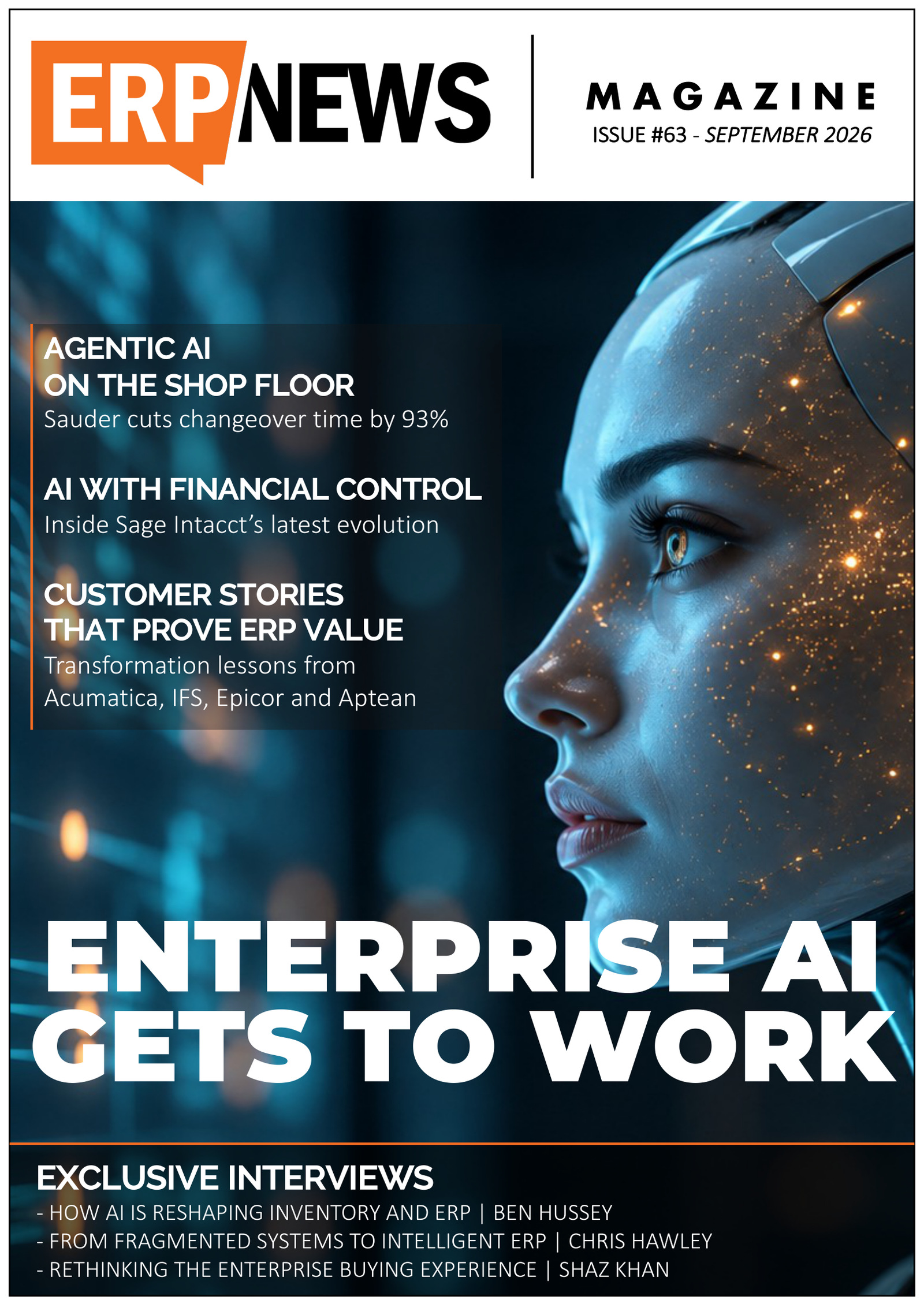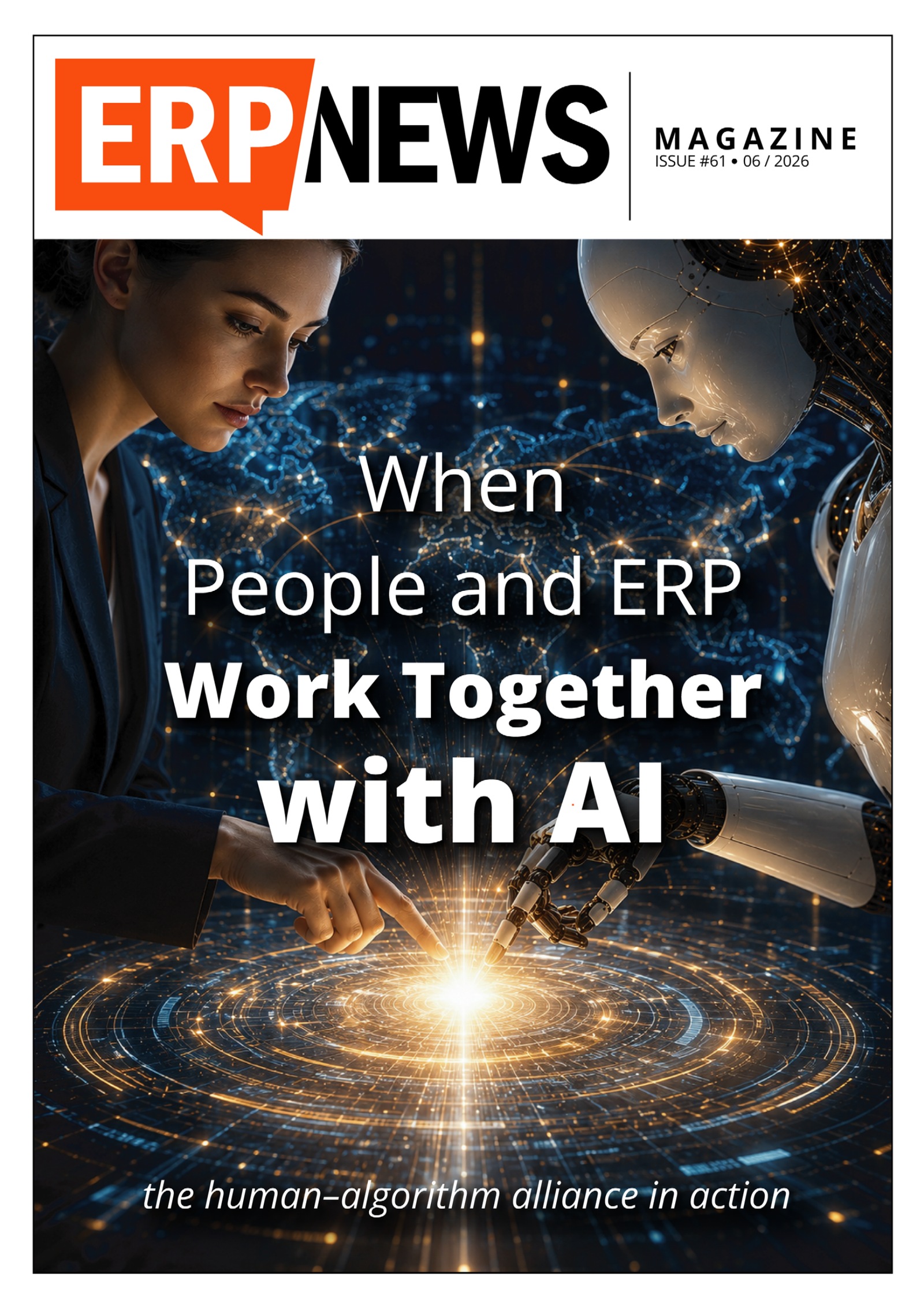
ERP for the Next Generation of Commerce
Connected commerce, intelligent operations
About this issue
ERP for the Next Generation of Commerce examines how enterprise systems are adapting to a marketplace shaped by connected customer experiences, changing supply chains and intelligent automation. Across 90 pages, Issue 62 looks at ERP as the operational foundation linking commerce, finance, projects, inventory and the decisions businesses make with their data.
Executive Interviews
Natalie Hammond, Head of Propositions Marketing at Access Construction, discusses the challenges facing specialty contractors and the need to connect work in the field with financial management. The interview explores Access Coins Evo, a platform designed to bring project delivery, service operations, payroll, compliance and accounting into a more consistent real-time view. Hammond considers how earlier visibility into labor, margins and project performance can help contractors respond before small issues become costly ones.
In a second executive conversation, Greg Mader, President of Gray Matter Logic, and Chris Cappelli, Executive Vice President, examine the future of ERP transformation. They discuss the growing importance of understanding a company’s operating model before designing its technology environment. Their perspectives cover modernization, composable applications, AI copilots and the role of an implementation partner in turning business requirements into systems that can continue to evolve.
Guy Leibovitz, Co-Founder and CEO of Nominal, focuses on enterprise finance. He explains why recording transactions and reporting on them do not, by themselves, remove the manual work of reconciliations, variance analysis and financial close. The interview explores AI agents as an execution layer alongside existing ERP systems, as well as the controls needed for finance teams to trust automated work.
Ideas Shaping Modern ERP and Commerce
The issue’s contributed articles address the practical questions behind AI adoption. CGI examines the full cost of agentic AI beyond model tokens. Forterro Orderwise considers how AI can support ERP and warehouse performance, while Rootstock explains the handoff between ERP and transportation management in supply chain execution. Aptean looks at governance and accountability for enterprise agents; Unanet explores how government contractors can act sooner on trusted ERP data; and Epicor discusses modernization for distributors using BisTrack.
Commerce and finance receive close attention. Salesforce examines shopping agents and new paths to product discovery. Infor Hospitality considers what businesses should expect from an AI technology partner. Unit4 addresses the quality of the financial data beneath AI tools, and Shopify provides a commerce-focused guide to ERP migration, including the need to protect customer, inventory and order experiences during a transition.
The news section covers developments from Odoo, Sage, Acumatica, SAP, Unanet, Aqurus Solutions, Trevera, IFS and Unit4. Together, these reports span ERP education, explainable AI in finance, acquisitions, industry-specific software, field service and access to enterprise data.
Five Customer Stories
Therabody uses Oracle NetSuite to bring its expanding global operations onto a more connected platform. The wellness technology company describes improvements to order management and productivity as it serves customers through multiple channels and countries; the story reports a 45% reduction in technology costs.
Osoth Inter Laboratories (OSI), a pharmaceutical and dietary supplement manufacturer in Thailand, is modernizing legacy processes with Rootstock and ComplianceQuest. Its story focuses on connecting manufacturing, quality and regulatory information so teams can reduce manual work and improve traceability across operations.
Merenda Foods, a producer of organic baby snacks and porridges, selected Aptean Food & Beverage ERP, built on Microsoft Dynamics 365 Business Central. The company replaced disconnected spreadsheets and applications with a shared operating foundation, going live within six months and within budget.
Lovepop describes a longer transformation journey with Odoo. As its greeting card business expanded, the company needed to connect its U.S. operations with manufacturing in Vietnam. The story follows the development of a unified ERP environment supporting production, inventory and other functions at a 4,000 m² facility with approximately 300 employees.
Marmon Water is rolling out Epicor Kinetic across its international businesses. The story examines how a common cloud ERP foundation and a repeatable implementation approach are helping the group connect sites while accounting for local needs. At the time described in the issue, three companies were live, with further locations in progress or planned.
Taken together, the interviews, analysis and customer experiences show what the next generation of commerce demands from ERP: dependable operational data, useful connections between teams and systems, and technology that helps organisations turn information into timely action.
Featured Content
Guy Leibovitz, Co-Founder & CEO of Nominal, on How AI Agents Are Redefining Enterprise Finance
In this ERP News Executive Q&A, Guy Leibovitz, Co-Founder and CEO of Nominal, discusses why finance teams need more than AI copilots, how autonomous AI agents are reshaping financial operations, and why the future of ERP lies in an execution layer that works alongside existing enterprise systems. He also shares his perspective on continuous close, governance, and what will distinguish finance organizations that successfully scale with AI over the coming years.
Read on ERPNews.com ↗AI, Operational Modeling, and the Future of ERP Transformation: A Conversation with Greg Mader and Chris Cappelli of Gray Matter Logic
In this executive Q&A, Greg Mader, President of Gray Matter Logic, and Chris Cappelli, Executive Vice President, discuss the evolution of ERP implementation, the growing importance of operational modeling, the role of AI in discovery and transformation projects, and why the future may belong to company-specific ERP strategies rather than one-size-fits-all industry templates.
Read on ERPNews.com ↗Connecting the Field to Finance: Natalie Hammond of Access Construction on Real-Time ERP for Specialty Contractors
In this ERP News Q&A, Natalie Hammond, Head of Propositions Marketing at Access Construction, discusses the operational challenges facing specialty contractors, the growing importance of integrated ERP platforms, the role of AI in construction technology, and how real-time operational intelligence is reshaping the future of construction ERP.
Read on ERPNews.com ↗Read Issue 62 Online
The magazine is loaded directly from ERP News servers.