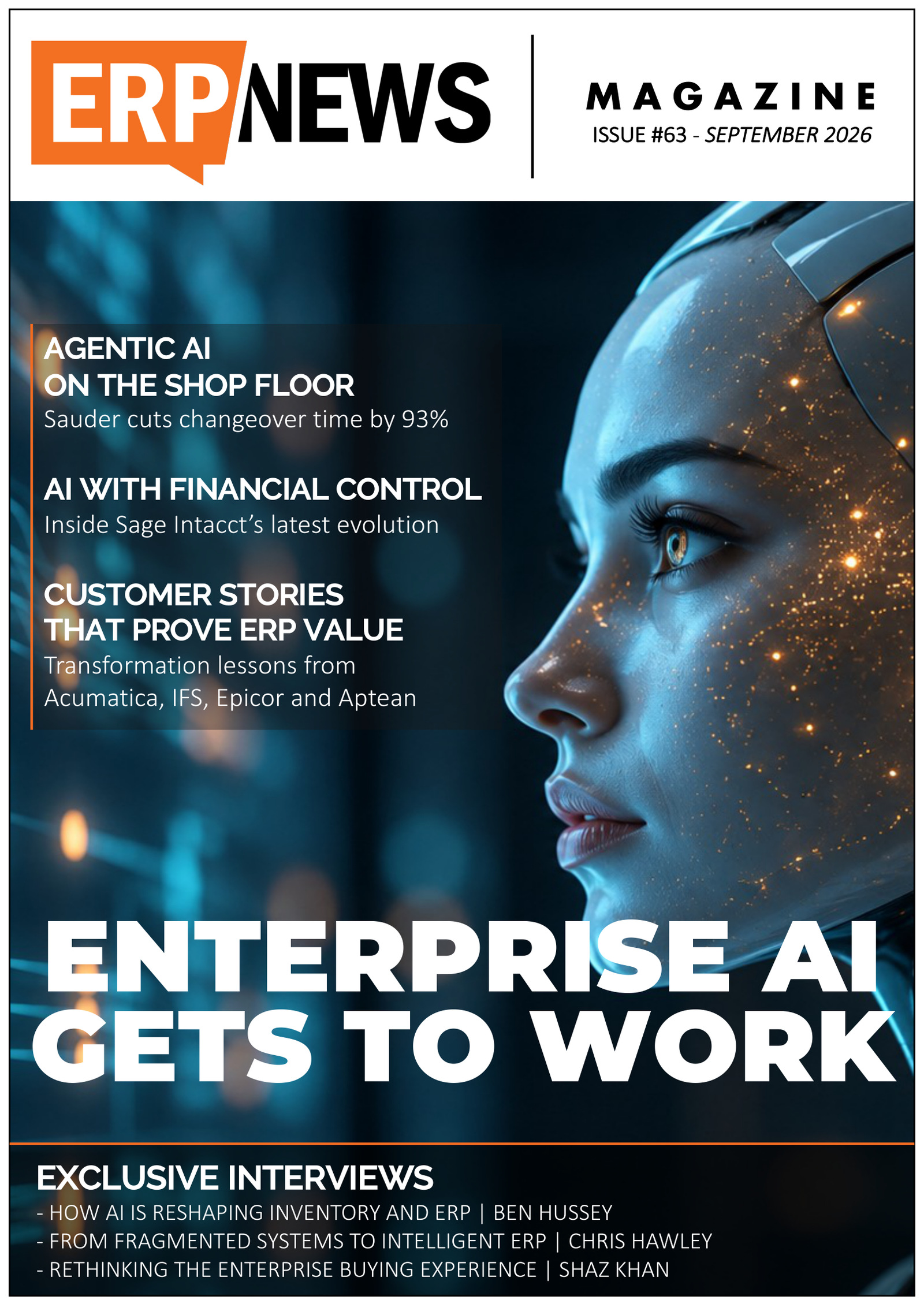
The Future of Work
How ERP, AI and workforce intelligence are reshaping roles and redefining productivity
About this issue
The Future of Work examines how ERP, AI and workforce intelligence are changing the tasks people perform, the information they use and the decisions they remain responsible for. As enterprise systems take on more routine work, Issue 64 asks a practical question: how can organisations gain the benefits of greater autonomy while keeping outcomes visible, governed and accountable?
Executive Perspectives on Work and AI
Eric DiProspero, Chief Revenue Officer at OpenGov, discusses the move from disconnected government applications to connected operations. His interview considers how shared data can link finance, budgeting, procurement, human capital management and public services. He also addresses responsible AI adoption: before an assistant can help government teams act on information, the underlying workflows, permissions and data must be dependable.
David Binny, CEO of Panaya, examines what enterprise testing must become as AI agents take on more work. An agent completing a task does not necessarily mean it produced the right business result. Binny discusses Change Impact Analysis, autonomous testing and continuous qualification as ways to examine the effects of changes across ERP and connected applications. His central concern is how teams can delegate execution while retaining evidence and accountability.
Two interviews focus on finance. George Kurdin, CEO and Co-Founder of Monk, explores AI agents in accounts receivable, including collections, cash application and the relationship between automation and ERP records. He draws a boundary around decisions involving money, commercial terms and sensitive customer relationships. Jean-Jacques Bérard, Chief Product and Technology Officer at Esker, considers a broader autonomous finance environment. He explains how AI reasoning can help resolve exceptions and coordinate work across ERP systems, while permissions, validation and approvals govern what an agent may actually do.
In manufacturing, Eric Okimoto, Founder and CEO of Widge, discusses the knowledge that experienced employees carry and the difficulty of making it available to the wider workforce. His interview explores how AI can connect technical documentation with ERP and CRM information so employees can find reliable answers at the point of work. Source traceability, controlled access and human review remain essential when an incorrect technical answer could affect a customer or production decision.
Stewart Monk, Chief Revenue Officer, and Chris Rauch, Chief Operating Officer at Proactis, turn to Source-to-Pay transformation. They discuss why implementation alone is a limited measure of success and why adoption, consistent processes and useful data determine whether procurement technology delivers lasting value. Their conversation also considers where AI can help and where organisations first need stronger operational foundations.
Research, Analysis and Industry Developments
A report on Unit4’s Canadian research examines the gap between digital transformation activity and genuinely connected public sector operations. A separate analysis by Ellen Rothschild of Rootstock considers how repeatable ERP-driven cost improvements may affect a manufacturer’s earnings and implied market value. Its financial figures are an illustrative model, rather than a reported customer outcome.
The news section follows SAP’s work on workforce intelligence and its planned acquisition of TechWolf; Infor’s changes to the manufacturing ERP experience; and the IBM and SAP approach to cloud ERP modernization. It also covers Fairline Yachts’ selection of SYSPRO and the industrial AI platform Torque, alongside Basware’s acquisition of Trustpair to extend financial controls from invoice validation toward payment verification.
Customer Stories: What Changed in Everyday Work
The four customer stories connect the issue’s ideas to operational results.
An unnamed global beverage manufacturer used Epicor Acadia to make frontline instructions and skills information easier to access as experienced workers retired. The published account describes simpler processes, digital standard operating procedures and broader cross-training. Epicor reports a 17% year-over-year productivity improvement; the customer’s identity is not disclosed in the story.
At its Mississippi facility, Tecumseh implemented Aptean TMS to bring freight audit, carrier rates and reporting into a more coordinated process. Its logistics team sought to reduce manual invoice reconciliation and gain clearer information for reviewing charges and negotiating rates. The published case describes operational improvements but does not provide a quantified savings figure.
Wayne Safety, a Canadian distributor of safety products, worked with CONTAX to deploy Acumatica Distribution Edition. The project paired cleaner data and staff training with defined warehouse bins, scanning procedures and stronger financial controls. The case reports a 35% improvement in order management, 15% fewer inventory errors and a financial close completed more than five days faster.
TOMRA North America used IFS to establish common field service processes and performance measures across its operations, later moving to IFS Cloud with Infosys. The published case reports first-time fix rates of 96–97%, up from 84%, and a 27% operational efficiency gain since the initial IFS investment. A proposed reduction in technician onboarding through future AI assistance is presented as an expectation, not an achieved result.
Across the issue, the common thread is the relationship between greater system capability and human responsibility. Connected information can help people act sooner; automation can expand their capacity. The value of either depends on clear processes, trustworthy evidence and an understanding of which decisions still require human judgement.
Read Issue 64 Online
The magazine is loaded directly from ERP News servers.
Featured Companies