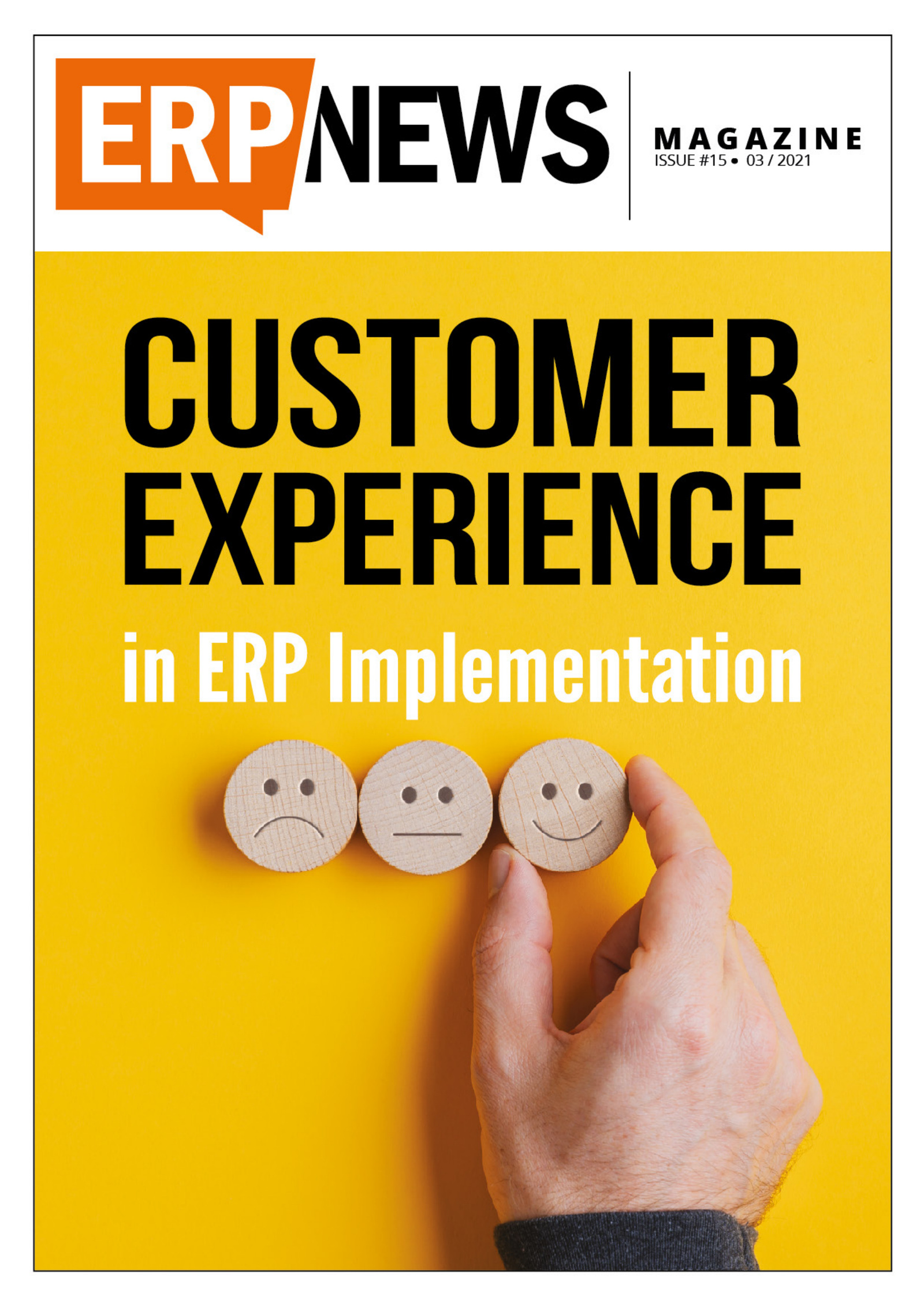
Customer Experience in ERP Implementation
Connecting ERP implementation, manufacturing operations and customer expectations, with IAS perspectives and Oracle and Infor customer stories.
About this issue
Customer Experience Starts Inside the Business
How much of a customer's experience is shaped by systems they never see? ERP News Magazine Issue 15, dated March 2021, examines customer experience in ERP implementation, connecting the implementation relationship with everyday activities such as order promising, production planning, delivery and service. The issue treats customer experience as an operational concern as well as a commercial priority. Its contributors consider how integrated information, responsive processes and trusted partnerships can help businesses adapt to expectations intensified by the pandemic.
Executive Perspective: IAS and canias4.0
Yasar Hakan Karabiber, Chairman of the Board of IAS, discusses the company's development from an ERP producer into a broader technology provider. His interview covers caniasERP, the TROIA development platform, the iasDB database, caniasIQ business intelligence and work involving IoT, cloud, AI and big data. He also describes changes to licensing, interface design, training and the company's international expansion priorities.
Karabiber reports turnover growth of 35% and team growth of 50% during 2020. These are company-reported historical figures; his ambition to grow by at least 100% across operating countries in 2021 is a target, not an achieved result. The interview's distinctive argument is that integrated technology and development flexibility can give customers more control over how their systems evolve. Its claims about replacing third-party applications are vendor positioning rather than evidence that every organization can dispense with external systems.
Customer Stories: Delivery and Food Manufacturing
Brazilian restaurant chain Cabana Burger uses Oracle MICROS Simphony POS, kitchen display systems and inventory capabilities while adapting to delivery-led demand. The announcement reports a ten-minute reduction in delivery time and a 400% increase in delivery orders compared with the previous year. Founder Paulo Bonifácio describes integrating with delivery providers and third-party applications, alongside greater independence in deploying the system at new restaurants. These outcomes are reported in an Oracle customer announcement during a major change in channel demand; they do not isolate the software's contribution from all other factors. Planned restaurant openings remain expansion intentions.
Levoni Group, the Italian cured-meat producer, selects Infor CloudSuite Food & Beverage, based on Infor M3 and Infor OS, with Atlantic Technologies managing the project. The selection responds to a need for integrated processes, traceability and the demands of consumers concerned with quality, transparency and sustainability. The planned solution spans slaughterhouse and cured-meat production, with approximately 230 intended users across Italian and American offices. The article describes an implementation decision and roadmap. Its expected improvements and later production-line, product-development and asset-management work are not completed outcomes.
Designing ERP Around the Customer
Zach Feige, Vice President of Professional Services at Rootstock Software, connects customer experience with manufacturing ERP configuration. His article examines shared customer information, coordinated workflows, inventory and supply chain management, production plans, complaint handling, service touchpoints and online engagement. Salesforce provides the platform context for Rootstock's approach. The emphasis is on aligning ERP, CRM and quality information so that internal decisions support more consistent external service.
Lucy Thorpe, Head of Content at InCloud Solutions, approaches experience through the relationship between an implementation partner and its customer. Trust, integrity, reputation and continuing support matter because implementation is an extended collaboration. She also considers the additional effort needed to build relationships remotely and describes regular, focused interactions. Her accompanying expert panel reinforces partnership and trust rather than presenting a separate customer case.
Puneet Kakkar, identified in his biography as an Oracle ERP Architect at Scientific Games Corporation, examines the connection between operational information and customer expectations. His discussion covers inventory, realistic delivery commitments, pricing, installed-base records and resolution of inquiries. Nishant Joshi, Technical Writer at Sage Software Solutions Pvt Ltd, adds a perspective on communication, response time, AI-assisted interaction and sustainability data. These contributions outline possible uses of ERP; they do not establish guaranteed retention gains, error-free decisions or universal financial returns.
Manufacturing, Services and Connected Ecosystems
Brent Dawkins, Director of Product Marketing at QAD, examines digital manufacturing under COVID-related disruption. Demand and supply planning, supplier collaboration, shop-floor connectivity and timely business insight form his practical framework. He recommends evaluating technologies through their contribution to operational performance, including smaller prototype projects before broader commitments.
Oracle's manufacturing CX contribution considers the transition from one-time transactions toward continuing customer relationships. Subscriptions, direct-to-customer channels, customization and proactive service illustrate business-model options supported by connected information. Joseph Clancey, Product Marketing Specialist at Oracle NetSuite, explores four sources of unprofitable services projects: limited visibility, weak collaboration, misaligned resources, and accounting or billing inaccuracies. NetSuite SuiteProjects illustrates the case for joining professional services automation with financial, CRM and HR information.
Two IFS contributions share a headline but address different subjects. The first explains the refreshed brand, IFS Cloud launch context and the moment-of-service positioning. The later article examines network effects, interoperability and the value of making collaboration easier across trading partners. Bernd Gross, CEO of Cumulocity and CTO of Software AG at publication, discusses IoT-supported distancing, occupancy information and remote monitoring. His examples concern workplace safety and continuity, without identifying a measured customer implementation for each scenario.
Research and Product Developments
A Forrester Consulting study commissioned by SAP, Qualtrics and EY highlights employee-experience priorities and the gaps between employee expectations, leadership sponsorship and organizational measurement. Epicor reports Stevie Awards recognition for its customer service department and executives Lisa Pope and Jason Taylor. The abas ERP 20 announcement describes process controls, dashboards, workflow automation, quality management, connectivity, electronic invoicing and authentication changes. Together, the issue places experience alongside execution: customer commitments depend on the information available, the processes connecting teams and the quality of the relationships through which ERP is selected, implemented and used.
Read Issue 15 Online
The magazine is loaded directly from ERP News servers.