Millennials and ERP
How changing workforce expectations are shaping cloud ERP, user experience, collaboration and analytics, with practical perspectives on modernization and connected operations.
About this issue
Enterprise software through the user's eyes
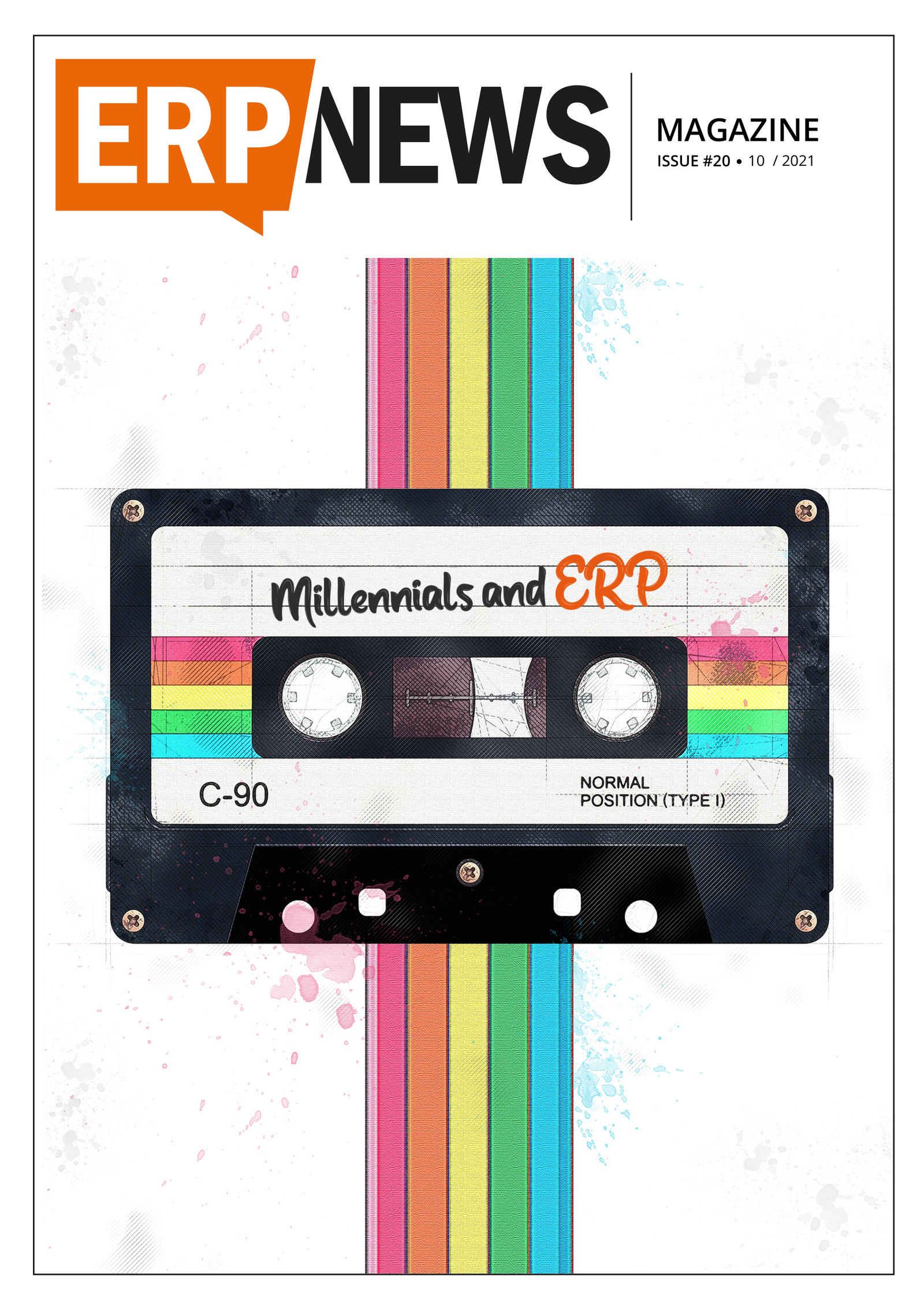
What happens when employees expect workplace software to feel as accessible as the digital services they use outside work? The October 2021 edition of ERP News Magazine explores this question through its cover theme, Millennials and ERP. Contributors examine mobility, intuitive interfaces, collaboration and timely information, connecting workforce expectations with modernization decisions. Their perspectives sit alongside manufacturing customer stories, financial-services analysis and industry news. Generational descriptions frame the discussion; individual needs and implementation requirements still deserve direct assessment.
Usability, access and changing expectations
Nishant Joshi, Technical Writer at Sage Software Solutions, identifies five priorities: cloud access, ease of use, manageable maintenance, cybersecurity and readable information. His article links software design with managers' ability to share data and make decisions. A separate Sage-associated contribution, “Millennials and ERP: The New Hit Duo,” considers mobile communication, customized dashboards and accessible analytics. Both present expectations for enterprise tools rather than evidence that every deployment delivers identical results.
Lucy Thorpe, Head of Content at InCloud Solutions, examines access from different locations, interface design, setup, training and collaboration. SAP Business ByDesign and SAP Analytics Cloud provide product context. Familiarity with consumer technology does not remove the need to learn business processes; bite-sized, self-service training remains part of her argument. A later expert panel reinforces the value of freeing employees from repetitive administration.
Isabel Ostermeier, Head of SAP Cloud SME UX, extends the discussion to Generation Z. She distinguishes brand-led personalization from user-driven individualization and considers responsive experiences across devices. Her total-experience perspective connects customer, employee and user experience. Allan Lessing, Director of Customer Solutions at OptiProERP, similarly emphasizes consistent workflows, mobile access, analytics and integrated modules, while acknowledging the need for coaching in unfamiliar industrial technologies.
Modernization and open architecture
Allen Jacot, Solution Architect and Oracle expert at Syntax, discusses the choices facing Oracle E-Business Suite customers. The interview addresses the publication-era support transition for release 12.1 and explicitly identifies upgrading to 12.2 as an option. Jacot recommends planning resources, timelines and data preparation, then mapping a staged cloud journey. His argument connects availability, remote access and collaboration with modernization; it does not establish that all EBS customers must replace their applications with cloud ERP.
Vladimir Collak, Vice President of Platform and Innovation at PDI Software, describes four elements of modern open architecture for fuel wholesalers and retailers: APIs, cloud services, accessible data, and AI or machine learning. These support integration and potential applications such as delivery visibility, pricing decisions and predictive equipment maintenance. Pam Washbon's Infor-associated article considers legacy replacement through Infor CloudSuite Industrial, focusing on disconnected spreadsheets, business-process review and remote working. Its benefits are proposed capabilities, not a measured implementation result.
Finance, service delivery and business models
Oracle's Juergen Lindner, Senior Vice President of Global SaaS Marketing, discusses research conducted with finance expert Farnoosh Torabi among more than 9,000 consumers and business leaders in 14 countries. He connects respondents' attitudes toward automation with future finance skills, continuous learning, communication and diverse perspectives. Survey responses about trusting robots are attitudes reported in that research, not proof that automated decisions are always more reliable.
Hayley Null's financial-services article draws on a Deloitte and NetSuite webinar, with perspectives from Deloitte Canada's Rakesh Shetty and Oracle NetSuite's David Silver. Mobile applications, employee experience, real-time analytics, automation, international operations, predictive modeling and cloud finance form its seven themes. An unnamed financial institution is cited as having automated request intake, handling 100 reports and 85 weekly requests. The reported benefit is capacity for more valuable work; no institution name or measured financial return is supplied.
IFS examines service-based and outcome-based business models using research involving more than 1,700 executives and 12,500 consumers. The discussion connects customer experience with coordination across the value chain. Juergen Utess's professional-services article uses SPI Research benchmarks to examine standardized delivery, central resource management and integrated financial information. Rather than relying indefinitely on remote delivery to improve margins, it argues for stronger visibility and service execution.
Customer stories and implementation boundaries
Filtra Systems connects its SYSPRO ERP with a reseller website and its own Amazon and Shopify stores using Codeless Platforms' BPA Platform. CIO Richard Lamey describes a reseller reaching roughly 300 daily orders, making manual handling impractical. Automated acknowledgments, shipment tracking and invoicing operate around six-minute data pulls. His estimate that manual processing would require ten people for a day illustrates avoided workload, rather than verified redundancies or a financial savings calculation. Time-clock integration remains a future project.
Alpar Metal IT Manager Serpil Altas describes caniasERP as the core connecting production information, canias4.0 IoT and business intelligence. Automatic data collection from machining and casting equipment supports efficiency measurement, quality workflows and operational analysis. She reports better visibility, customer satisfaction and profitability, alongside easier remote working during the pandemic. No numerical efficiency uplift is provided, and further manual-workcenter automation and improved finite-capacity planning remain development goals.
Ortec Group's selection of IFS Cloud concerns a planned common management foundation across 229 agencies and 11,500 employees. Finance, purchasing and project management are central to its goals for multi-site and international coordination. The announcement describes selection and intended improvements, rather than completed rollout results.
BT's selection of Oracle Communications policy management targets faster 5G service design and deployment across EE's network. Forecast improvements are presented as expected benefits. Other news covers SAP Product Footprint Management, Agiloft's leadership and partner expansion, Auditoria.AI's Constellation Research competition recognition, and NTT DATA's sixth-place position in the 2021 IDC FinTech Enterprise 25 ranking. James Mallory's Acumatica article closes the manufacturing discussion by examining cloud ERP capabilities for reshoring. Across these contributions, the issue connects accessible enterprise software with deliberate process design, integration and realistic expectations.
Read Issue 20 Online
The magazine is loaded directly from ERP News servers.