Smarter and More Intuitive ERP
Epicor's Andy Coussins, Agiloft's Andy Wishart and Prophix's Alok Ajmera discuss industry expertise, connected contracts and finance transformation, alongside perspectives on ERP trends for 2022.
About this issue
Looking ahead through industry knowledge and connected information
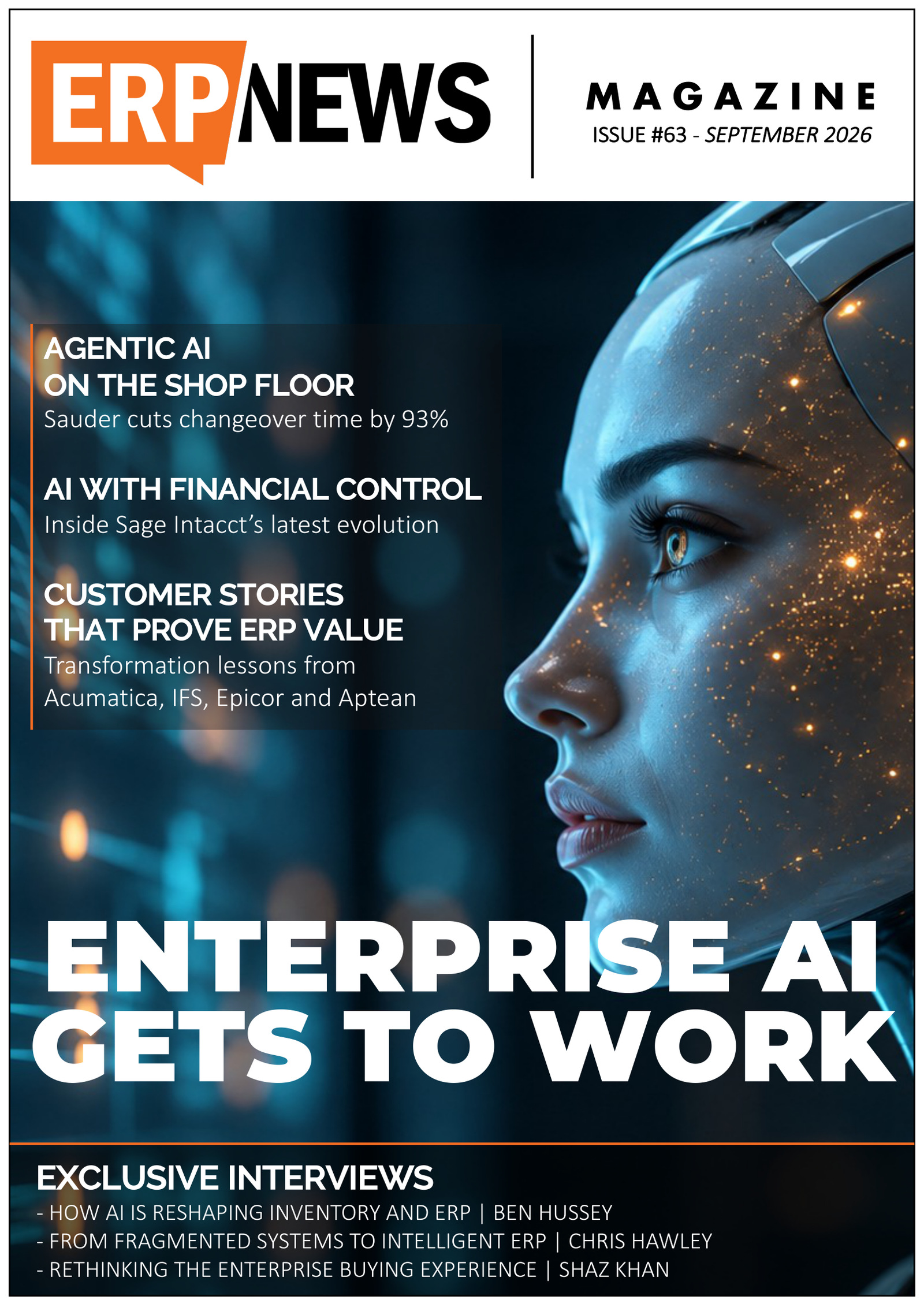
How should ERP evolve as businesses face changing supply chains, distributed teams and greater expectations of digital services? ERP News Magazine Issue 22, December 2021 by its cover date, explores Smarter and More Intuitive ERP through three executive interviews and a broad outlook for 2022. Editor Yagmur Sahin introduces a year of innovation shaped by lessons from the pandemic. Contributors examine the relationship between industry-specific functionality, accessible information, automation and the people using enterprise systems.
Three executive interviews
Andy Coussins, SVP & Head of International at Epicor, describes an approach built around industry expertise, customer relationships and investment in employees. He discusses software for automotive, building supply, distribution, manufacturing and retail, alongside customer input into product development. Smarter ERP, in his account, must be intuitive, extendable and available where work happens, including warehouses, production environments and remote locations.
Coussins connects cloud adoption and implementation methods with dashboards, analytics, manufacturing execution and supplier communication. He also discusses CPQ and visual configuration as ways to connect buying decisions with procurement and production. These are product and strategic perspectives rather than measured results from a named customer. His 2022 growth plans emphasize deeper customer partnerships and acquisitions aligned with Epicor's core industries.
Andy Wishart, CPO of Agiloft, examines the movement of contract lifecycle management from a legal repository toward an enterprise system of record. His interview discusses the 2021 Winter Release, configurable workflows and connected experiences in tools employees already use. Microsoft Teams integration lets users view progress and approve contracts, while connections with ERP and CRM aim to make contract information more useful across departments. Wishart recommends evaluating configurability, approval automation, integrations and repository capabilities. Further releases for 2022 remain plans from the interview's perspective.
Alok Ajmera, CEO and President of Prophix, discusses CPM's role in budgeting, forecasting, reporting and trustworthy decision support. He explains how the Sigma Conso acquisition expands consolidation expertise and geographic reach, following Hg's investment. His selection guidance covers requirements, demonstrations, pricing, reviews and peer recommendations. Ajmera also describes AI-supported financial analysis and plans for research, cloud growth and international expansion. Market-leadership ambitions and expected acquisition benefits are attributed strategic claims.
Manufacturing and the value of industry detail
Glen Graney of QAD examines additive manufacturing's implications for ERP. Printing is only one part of a production route: post-processing, shared equipment, scheduling, powder reuse, material consumption and costing all need attention. Contract manufacturing, intellectual property and the digital thread add further complexity. His article argues for adaptable supporting systems rather than treating 3D printing as a standalone technology purchase.
Nouman Ahmad, Co-founder and CEO of Validere, considers inventory visibility in oil and gas. Commodity composition changes as materials are blended, processed and transported, so volume alone is insufficient. He proposes collecting native data, validating measurements, augmenting gaps with models and preserving an auditable structure. The intended commercial, operational and environmental benefits depend on better information; the article does not provide a named customer's measured margin or emissions improvement.
Chenthil Eswaran, Practice Head of Enterprise Business Applications at Aspire Systems, contributes articles on finance automation and ERP trends. He distinguishes retrospective reporting from timely decision support and connects automation value with processes beyond finance. Mobile-first working, real-time information, analytics and intelligent workflows are presented as directions for 2022, with adoption and organizational dependencies shaping their usefulness.
ERP platforms, data accessibility and supply-chain intelligence
Lucy Thorpe of InCloud Solutions draws on Sapphire Systems strategist Chris Gabriel's ideas about ERP becoming part of a wider digital operations platform. The article considers workflows, service-based business models, traceability and ESG information, with a speculative view toward 2030. Mary Sibley and Jason Schaps of SAP examine quicker benefits, intuitive systems, predictive capabilities and industry fit. Their Vast Bank example describes qualitative improvements in real-time responsiveness and customer relationships, without identifying the precise ERP product or quantifying results.
Allan Lessing, Director of Customer Solutions at OptiProERP, surveys cloud, mobile, AI, IoT, additive manufacturing, two-tier deployments and marketing data. Nishant Joshi of Sage Software Solutions Pvt Ltd adds integration, conversational interfaces, personalization and ecommerce. Kyle Foley, Co-Founder of Polyture, focuses on visual data pipelines and accessible analytics for midmarket businesses. Erna Clayton's closing trends contribution also considers hybrid deployments, mobile operations and the continuing difficulty of making AI and BI usable for ordinary employees.
Saratendu Sethi, Vice President of AI at GEP, argues for combining quantitative models with qualitative information, sustainability objectives, scenario planning and conversational tools. His Port of Montreal CargO2ai example concerns prioritizing essential goods, without a quantified improvement in the supplied text. Emily Newton, Editor-in-Chief of Revolutionized Magazine, examines AI, IoT and distributed records as tools for logistics visibility and traceability.
Customer transformation and industry announcements
Valmet selected Infor CloudSuite as the next phase of an ERP program begun in 2016. The planned move covers more than 10,000 users in over 30 countries, using Infor's multi-tenant cloud on AWS. The article describes intended operational consistency, reporting and extensibility, without claiming the migration is complete or supplying measured cloud savings.
Other news includes Oracle Learning's LinkedIn Learning integration, SAP's learning-platform recognition and Responsible Design and Production launch, Syntax's AWS Premier Partner status, Percipient's Sage Intacct partner award and John Davis's appointment as Global Shop Solutions CTO. Together, the issue presents smarter ERP as a combination of industry relevance, connected processes, usable data and the ability to keep adapting.
Read Issue 22 Online
The magazine is loaded directly from ERP News servers.