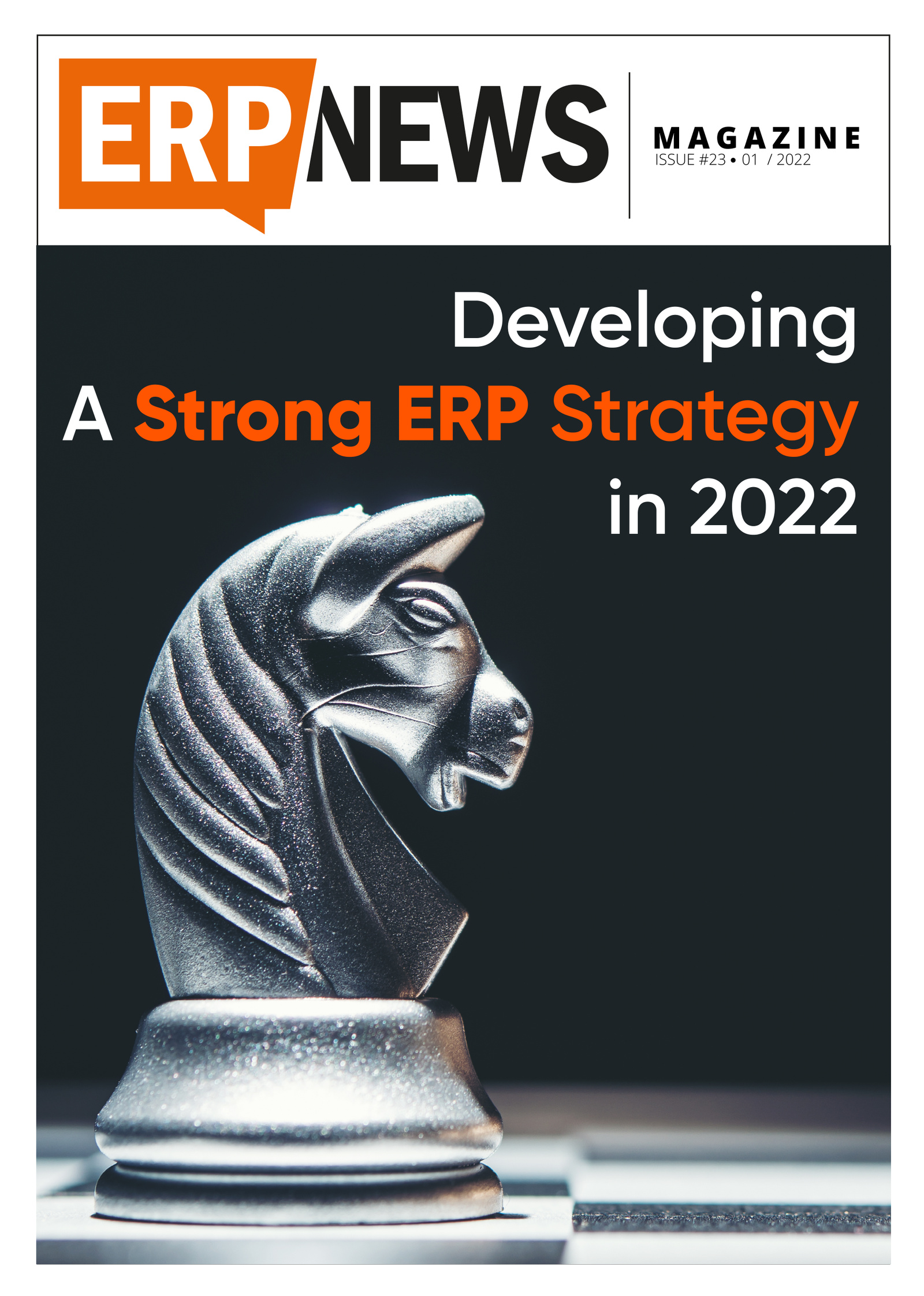
Developing a Strong ERP Strategy in 2022
Build an ERP strategy around business goals, implementation readiness and people, with a Sage People interview, QAD and OptiProERP guidance, finance perspectives and customer experiences.
About this issue
Preparing ERP for a changing business
What should a business establish before selecting, implementing or extending its ERP system? ERP News Magazine Issue 23, January 2022, examines Developing a Strong ERP Strategy in 2022 through practical implementation guidance, an executive interview, technology perspectives and customer experiences. Editor Yagmur Sahin introduces strategy as a way to prepare for continuing disruption. Across the issue, contributors connect enterprise systems with business objectives, workforce needs and the ability to adapt after go-live.
A workforce perspective on enterprise strategy
Paul Burrin, VP of Sage People, discusses the changing role of HR during the pandemic in the interview Make Real Change for the Future. He identifies new ways of working, competition for talent and business transformation as major areas of focus. Flexible work, wellbeing, culture and employee expectations make workforce information relevant to decisions across the organization.
Burrin describes configurable HR workflows, dashboards and sentiment information as tools for responding to changing needs. His discussion of diversity, equity and inclusion goes beyond representation counts to consider roles, pay and progression opportunities. He links a strong ERP strategy with workforce visibility, actionable analytics and iterative improvements. The interview also reviews Sage People's U.S. benefits capability with PlanSource. These are historical product and executive perspectives, without a named customer's measured retention or productivity outcome.
From business drivers to implementation discipline
Bas van Nistelrooij, Vice President of Solutions and Vertical Marketing at QAD, sets out seven strategic priorities: industry knowledge, a capable implementation team, compelling business drivers, speed to benefit, scope discipline, preparation for disruption and a durable vendor partnership. He warns that departmental wish lists can displace the outcomes a project was intended to deliver. Future operating needs, training and continuing improvement belong in the strategy from the outset.
Allan Lessing, Director of Customer Solutions at OptiProERP, extends that discussion across discovery, analysis, planning, design, development where required, data migration, testing, training, deployment and support. His framework emphasizes cross-functional ownership rather than treating ERP as an IT-only project. Budget contingencies, clean data, user feedback and preparation for changed roles accompany the technical work.
Lucy Thorpe of InCloud Solutions focuses on streamlining, optimizing, integrating and automating. She connects intelligent ERP with ecommerce, workflows and analytics, while discussing SAP Business ByDesign and the wider Sapphire Systems approach. Unit4 CTO Claus Jepsen's expert panel adds modular applications, open APIs, composable architecture and data validation at the edge. Nishant Joshi, Technical Writer at Sage Software Solutions Pvt Ltd, contributes both an expert panel and an article on headless ERP, self-service, cloud, IoT, mobile access and two-tier deployments.
Finance adoption and expectations for 2022
Chenthil Eswaran, Practice Head of Enterprise Business Applications at Aspire Systems, examines why digital adoption in finance depends on people as well as automation. He discusses management support, communication, skills, usability and support arrangements, alongside budgeting, analytics and performance monitoring. Technology uptake should be assessed against useful changes in work rather than software availability alone.
Prophix CEO Alok Ajmera considers dynamic planning, operational alignment, targeted intelligent automation, zero-based budgeting and AI-assisted finance. His broader outlook also addresses ESG and cybersecurity. Joe Thomas's FinancialForce article similarly presents predictions about forecasting, information security, hybrid work and shared purpose, while cautioning about the difficulty of turning experimental AI into production systems. Both contributions are outlooks from the beginning of 2022, not retrospective evidence that every prediction occurred.
Customer experiences and connected planning
Qatar Airways implemented Oracle Fusion Cloud EPM, with Oracle Consulting as implementation partner, to address manual financial processes and systems that struggled to support expansion. The story describes connecting financial and operational information across HR, finance, supply chain and sales. CFO Daniel Ho highlights scenario modeling and faster responses to uncertainty. Improved reporting, visibility and planning are reported qualitatively; the article supplies no measured reduction in planning time or quantified ROI.
Industrial Specialty Services appears in Acumatica CEO Jon Roskill's review of 2021. The mechanical-services business wanted a cloud platform that reduced its responsibility for servers and network infrastructure. Working with BDO Digital and NexTec Group, it implemented Acumatica under challenging time pressures. The account describes real-time data, flexibility and usability, without a precise implementation duration or quantified savings. Roskill also reviews product releases, geographic expansion, partnerships, integrations and sustainability recognition.
Bamboo Rose is the named customer in 3i Infotech's managed-services announcement, despite the generic headline. The multi-year agreement covers infrastructure management and Microsoft cloud services globally, with a proposed joint market approach. CTO Kamal Anand reports monitoring and operational support benefits while describing a centralized cloud operations center as an objective. The article provides no numerical service improvement or contract value.
Cloud choices and industry developments
Syntax examines public, private and hybrid cloud models, emphasizing workload requirements, legacy applications, customization and data handling. Unit4's project-based ERP article considers resource planning, time capture, billing, talent and financial management for services organizations. Priority's Efrat Nakibly, VP Marketing & Strategy, surveys self-service, low-code development, headless interfaces, AI, IoT, mobile operations and two-tier ERP as evolving options.
The news section includes Oracle's agreement to acquire Cerner, subject to approvals and closing conditions; Agiloft's partnership with TCS; Aptean's acquisition of JET ERP in Austria; and Kate Bishop's appointment as IFS CHRO. SAP's analyses discuss Omicron-related supply-chain disruption and the need for more comparable climate disclosures. Together, the issue argues for aligning technology decisions with business priorities, people, information quality and continuing operational change.
Read Issue 23 Online
The magazine is loaded directly from ERP News servers.