The Digital Transformation Roadmap for SMEs
Sage's Dan Miller and Prophix CTO Geoffrey Ng discuss transformation, financial management and conversational AI, alongside practical SME roadmaps, customer experiences and cloud ERP analysis.
About this issue
A roadmap built around business outcomes
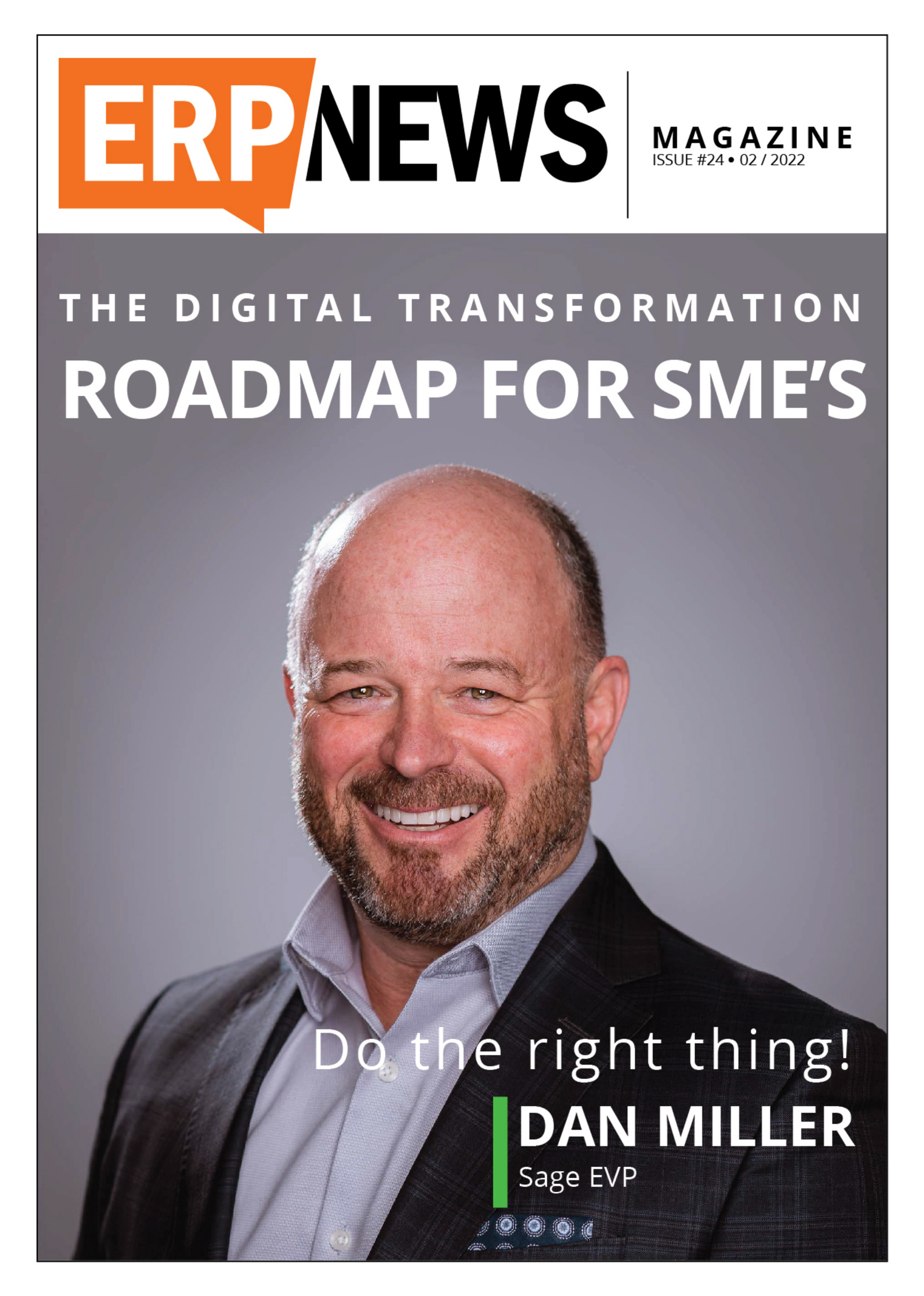
Where should a small or midsize business begin its digital transformation, and how can it keep technology choices connected to real needs? ERP News Magazine Issue 24, February 2022, explores The Digital Transformation Roadmap for SMEs through executive interviews, practical guidance and customer experiences. Editor Yagmur Sahin emphasizes the importance of both software and implementation partners. Across the issue, contributors connect modernization with business processes, financial visibility, employee participation and a clear view of customer value.
Executive perspectives: finance, people and artificial intelligence
Dan Miller, EVP of Sage Intacct at Sage, describes transformation as a change in how organizations work, combining digital interaction, collaboration and automation. His interview discusses cloud-enabled continuity, Sage People, financial automation and developments in AI-assisted time capture and general-ledger outlier detection. He argues that SMEs should define business goals before building their technology strategy, rather than simply recreate existing processes in new software.
Miller's implementation guidance centers on executive sponsorship, a capable project team, clear requirements and continuous change management. Communication should explain the desired future state and why it matters, while giving employees opportunities to respond. His discussion of Sage's social initiatives, sustainability commitments and product direction distinguishes long-term goals from completed outcomes.
Geoffrey Ng, CTO of Prophix, examines conversational AI in corporate performance management and FP&A. He describes the Virtual Financial Analyst's natural-language interaction and anomaly detection, while acknowledging that finance terminology, context and accuracy create substantial challenges. A query about revenue may require distinctions between products, services, regions and periods that an assistant cannot safely assume. Ng presents greater automation as a developing direction, emphasizing the trust and reliability needed before widespread adoption. The interview's industry-first wording is a vendor claim, and its market forecasts are historical expectations.
Financial transformation and practical SME planning
John Froelich, Senior VP of Digital Services for Treasury and Leasing at Bramasol, argues that a transformation roadmap should account for recurring-revenue business models and the financial systems supporting them. Billing, pricing, collections, cash visibility and revenue management become central as products evolve into services. His unnamed customer examples describe faster pricing and service launches, but do not establish a universal ROI benchmark.
Several contributors offer complementary roadmap perspectives. Jack Payne of Aptean recommends a cross-functional review of processes and information flows, followed by industry-specific functionality, automation and connectivity. Lucy Thorpe of InCloud Solutions begins with the customer experience the business wants to create, then advocates an audit, phased delivery and employee involvement. Her article includes Sapphire Systems' description of an unnamed intelligent-transport project connecting maintenance information with cloud ERP; no measured deployment outcomes are supplied.
Infor Industry Principal Jon Devine organizes the journey into three steps: define the starting point, establish the intended business direction and map the future digital ecosystem. He allows for useful existing applications to remain integrated. Expert panels from Unit4 CIO Shivkumar Gopalan and Syntax Chief Solution Architect Colin Dawes add end-to-end processes, data quality, leadership and organizational collaboration. Frank Hamilton's ERP guidance covers requirements, total cost of ownership, partner selection, staged implementation and continuing training.
Customer experiences: reported results and intended changes
Vitamin Angels migrated from manual accounting processes to Sage Intacct to support complex nonprofit reporting and restricted funding. The article reports a 60% improvement in accounts payable efficiency, $200,000 in identified logistics savings and 10 hours per month saved in revenue data entry through Salesforce integration. It also links improved reporting and donor confidence with $14 million more restricted revenue over three years. These are attributed customer/vendor results; the funding increase is not a guarantee that software alone raises donations.
Oracle Red Bull Racing describes using Oracle Cloud Infrastructure for race-strategy simulations and fan engagement. The announcement reports a thousandfold increase in simulations and tenfold faster simulation speed during the preceding season, alongside growth in fan-platform sign-ups. Expanded engine-development, training and esports applications are plans from the 2022 announcement. The championship provides context rather than proof that cloud technology independently caused the sporting result.
FinancialForce's services-automation news includes three customer perspectives. Traction on Demand reports an automated portfolio view and 100% ROI, without the calculation or time horizon. BeyondTrust describes real-time visibility and 20% higher global utilization, without clarifying percentage points versus relative change. 1E offers a qualitative account of Salesforce integration and departmental access. Syntax's digital-twin article separately describes an unnamed furnace manufacturer's asset-visibility use case; runtime-based customer billing remains a planned revenue model.
Adaptive systems, connected assets and service delivery
Kristin Poulton of QAD's Marketing Communications team discusses adaptable processes, availability, language support, localization and reporting in cloud ERP. Todd McElroy, Head of Sales at Priority U.S., examines AI-assisted analysis, forecasting, automation and customer experience while retaining a role for human expertise. Syntax connects industrial IoT and SAP Intelligent Asset Management with relevant sensor data, maintenance history and digital twins. Emily Newton, Editor-in-Chief of Revolutionized Magazine, considers retail IoT applications such as queue monitoring, smart shelves and cashierless stores. IFS Industries SVP Antony Bourne discusses telecom field service, customer self-service and connecting legacy systems with modern workflows.
Industry announcements and a continuing journey
IBM and SAP expand their cloud relationship through RISE with SAP and IBM's consulting offerings. NTT DATA, Acorio and ServiceNow present executive perspectives on continuous transformation. Agiloft and Ready Computing announce a healthcare CLM partnership; Ready Computing describes becoming a partner after using Agiloft itself. Other news includes Unit4's appointment of Tom Ascroft as CISO, the NetSuite Accelerator program with Capital Factory and Lumenia's planned March 2022 ERP comparison event. Together, these contributions frame transformation as a continuing business discipline requiring clear objectives, reliable information and organizational commitment.
Read Issue 24 Online
The magazine is loaded directly from ERP News servers.