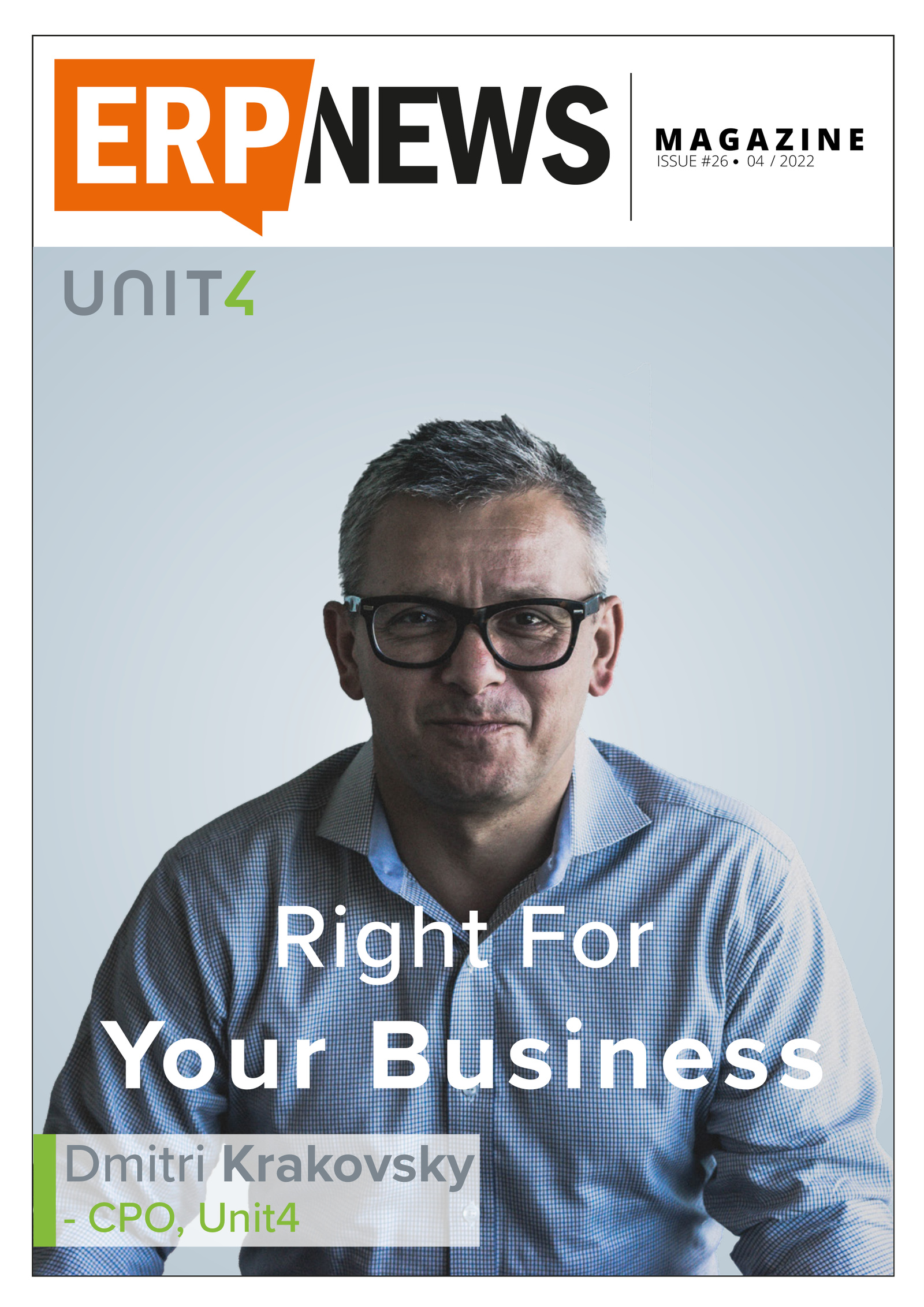
Right For Your Business
Unit4 CPO Dmitri Krakovsky discusses people-centric cloud ERP and the XaaS economy, alongside an Avalara tax compliance interview, customer experiences and analysis of manufacturing, planning and resource management.
About this issue
Choosing technology around the business and its people
What makes an ERP system fit the organization it serves? ERP News Magazine Issue 26, April 2022, explores Right For Your Business through a cover interview with Unit4 Chief Product Officer Dmitri Krakovsky. Across service organizations, manufacturers, distributors and finance teams, the issue examines how enterprise applications can support changing business models while keeping people, information and operational needs in view. Editor Yagmur Sahin connects the discussion with digital transformation and the growing complexity of online commerce.
Executive perspectives: purpose, flexibility and compliance
Krakovsky describes an XaaS economy requiring adaptable systems and close attention to customer needs. Unit4 focuses on people-centric sectors, including professional services, nonprofits and the public sector. He discusses cloud-native ERPx, industry practices, localization and the Industry Mesh approach to connecting ERP with collaboration tools and specialist applications. His argument is that modern architecture must be accompanied by a functional fit with the way an organization works.
The interview also examines Unit4 FP&A. Krakovsky emphasizes flexible planning, user-driven adaptations and integration of actuals, budgets, plans and forecasts. These are descriptions of the product approach and intended value rather than measured results from a named implementation. His people-centered perspective positions ERP as a foundation for employees delivering services and fulfilling an organizational purpose.
In the second interview, Avalara's Scott Peterson discusses government relations and U.S. tax policy. He explains how ecommerce growth can create obligations across jurisdictions and why SaaS businesses face additional complexity when products evolve faster than legislation or users consume services in several states. Peterson describes automation across registration, calculation, exemption management and returns, and considers stronger enforcement and movement toward real-time compliance. The interview belongs to the issue's historical tax context. A separate Gail Cole article discusses SaaS and economic nexus using older post-Wayfair examples and forecasts, which should be read as archival material.
Customer experiences: growth, visibility and automation
Undercover Snacks replaced QuickBooks with Oracle NetSuite as sales and operational complexity increased. The article describes connected production, customer, supplier, warehouse and financial data, with centralized orders supporting fulfillment and invoicing. Inventory controls include expiration information and alerts; EDI connections support visibility across trading partners. The company also recently implemented NetSuite WMS. Its expansion from approximately 2,000 to more than 10,000 stores provides business context, without establishing that ERP alone caused that growth.
Eagle Fence Distributing appears in Debra Mignola's Acumatica distribution article. President Keith Ford describes rapidly updating replacement costs during supply-chain price fluctuations and reports 99.9% uptime. This is a customer statement without a specified measurement period, rather than a universal service guarantee. Mignola, Director of Product Management - Distribution at Acumatica, uses the example alongside discussion of RFID and IoT visibility, automation, AI and machine learning.
COFINA's Oracle story concerns selection and a planned banking modernization beginning with its Côte d'Ivoire subsidiary. Oracle FLEXCUBE Universal Banking, Digital Experience and Payment Hub are intended to support digital services for underserved small and midsize businesses. The story describes expected improvements; it does not report completed migration results or measured loan-processing acceleration.
Lucy Thorpe and Mark Wheeler's Sapphire Systems article adds compliance automation examples. An unnamed car insurer reportedly automated 35% of its back-office function, with five initial bots live in three weeks. Its comparison between 117 potential staff and a cap of 20 concerns a five-year staffing forecast. An unnamed UK private wealth organization reportedly shortened pension-advice preparation from 27 days to four hours and expanded compliance checking from 20% to 100%. These are attributed customer accounts, not general automation benchmarks. Anna Maxim of The Credit Thing separately describes transaction alerts and automated sampling of customer conversations.
Manufacturing, procurement and operational planning
Caleb Finch of QAD's Marketing Communications team traces procurement from manual requisitions to integrated supplier management, purchasing visibility, blanket orders and automated discounts. Johan Pintens, Managing Director, Western Europe at Priority Software, examines bidirectional lot traceability, product genealogy, shelf life, quality records and mobile data capture. Epicor's manufacturing transformation guide connects analytics, industrial IoT, cloud computing, additive manufacturing, augmented reality and AI with leadership, skills and a culture of experimentation.
Prophix CTO Geoff Ng argues that financial plans need detailed operational drivers, including production output, customer characteristics and other nonfinancial attributes. His discussion of Detailed Planning Manager links operational models with financial statements and workflow. The ERP shortlisting article, attributed to Jim Reilly and accompanied by Infor company information, considers industry fit, deployment, user experience, accessibility and protection against disruption. Syntax analyzes Oracle EBS 12.2.11 user-experience changes, including Enterprise Command Centers, dashboards and the Redwood theme.
People, industry developments and future choices
In a separate FinancialForce article, Jim Reilly, Vice President of Global Professional Services, considers resource management during the Great Resignation. He advocates balancing utilization with employees' skills, aspirations and workload. Kenny Ingram of IFS examines infrastructure investment, whole-life asset costs, modern construction methods and service-based revenue opportunities.
The news section includes SAP's recruitment initiative for refugees from Ukraine, Steve Niesman's admission to the Forbes Business Council, Sage's finance-leader research and Sage Intacct's CRN partner-program recognition. Odoo promotes its planned October 2022 Experience event and Odoo 16 launch. Adrian Akers of TrustQuay contributes a separate compliance automation perspective. Together, the issue treats ERP fit as a continuing relationship between business processes, connected data, employee needs and organizational change.
Read Issue 26 Online
The magazine is loaded directly from ERP News servers.