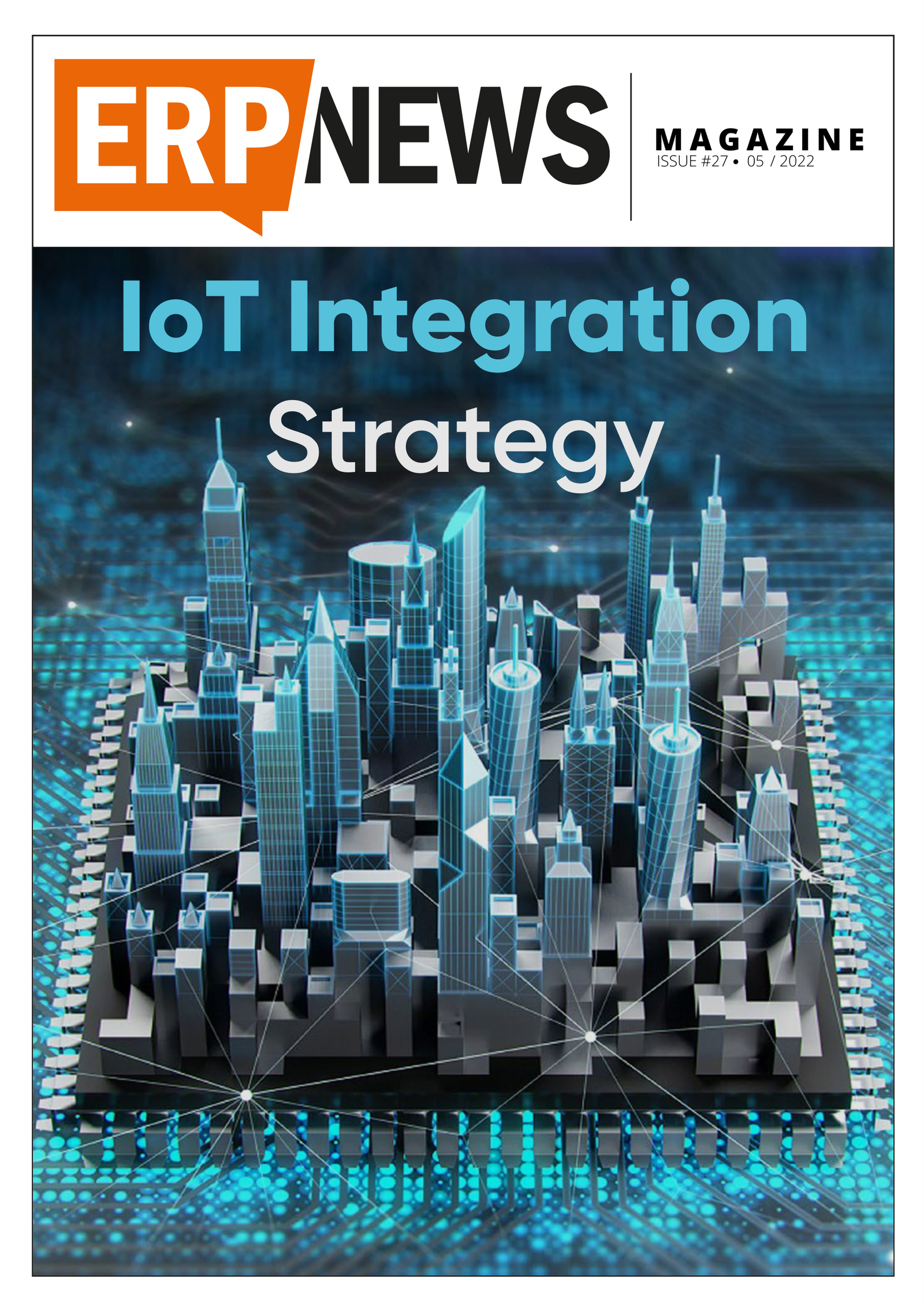
IoT Integration Strategy
Connecting devices, people and enterprise data: explore IoT-enabled mobile applications, warehouse automation and ERP integration, alongside an interview on SYSPRO and Priority CPX payment automation.
About this issue
Connecting operational signals with enterprise decisions
How can businesses turn information from machines, shipments and people into useful decisions inside ERP? ERP News Magazine Issue 27, May 2022, examines IoT Integration Strategy through mobile application design, manufacturing operations, warehouse management and enterprise collaboration. Editor Yagmur Sahin introduces the need for an integration roadmap that connects device data with business priorities. The issue also considers subscription tax compliance, finance leadership, corporate social responsibility and cloud migration.
IoT in environments where connectivity cannot be assumed
Vaidya Aiyer, CEO of Pillir, explains how low-code mobile applications can connect IoT environments despite intermittent networks. His agricultural equipment example concerns an unnamed global manufacturer seeking to expand maintenance services for sensor-equipped tractors. The proposed mobile approach collects equipment data through operators' smartphones and relays it when connectivity returns. The article describes a design opportunity rather than a quantified customer outcome.
An unnamed food logistics company provides a second example. Pillir describes phone applications that collect temperature readings from refrigerated shipments during transport and upload them in connected areas. Tracking follows individual shipments even when routes or drivers change. No measured reduction in spoilage or operating cost is supplied.
The third example concerns an unnamed international construction company coordinating close to 20,000 workers across subcontractors and challenging sites. Customized applications, sensor-linked identification cards and phones support records of time, location and equipment use. Data can be transmitted after workers return to coverage. The account illustrates workforce visibility without identifying the customer or supplying a measured productivity gain.
Allan Lessing, Director of Customer Solutions at OptiProERP, broadens the discussion to supply-chain tracking, production visibility, quality, forecasting, maintenance and resource efficiency. He also identifies security, bandwidth, older machinery and implementation cost as constraints. His recommendation is to begin with a focused use case whose business value can justify the integration effort.
An executive conversation about supplier payments
The issue's interview brings together Sanjay Ejantkar, Vice President of Alliances at SYSPRO USA, and Steve Tackett, Executive Vice President and Head of the B2B division at Priority Technology Holdings. They discuss Automated Payables for SYSPRO, powered by Priority CPX. Ejantkar describes an ecosystem approach that connects specialist applications with manufacturing and distribution ERP. Tackett explains how payment technology and supplier-enablement services work together to move eligible payments from checks toward electronic methods.
The interview describes payments initiated within SYSPRO, with CPX handling payment execution and remittance in the background. ACH, virtual cards, checks and wires provide different payment options; selected methods may generate revenue sharing. Potential rebates, reduced manual work and improved accuracy are vendor claims rather than audited outcomes from a named customer. The discussion also connects supply-chain resilience with analytics, sourcing choices and collaboration beyond the enterprise. Priority Technology Holdings, the payments company in this interview, is distinct from Priority Software, which contributes the CSR article elsewhere in the issue.
Warehouse automation and adaptable business systems
Debra Mignola, Director of Product Management - Distribution at Acumatica, examines collaborative robots, warehouse management systems, automated storage and retrieval, guided vehicles, autonomous mobile robots, RFID, cloud operations, modular facilities and predictive maintenance. Her practical emphasis is on understanding workflows and securing employee participation before investing. Acumatica WMS capabilities are presented as product functionality, while industry forecasts and illustrative maintenance figures are not customer results.
Cristina Recchia, MBA, PhD, considers how organizational expectations shape SaaS adoption. Her article, accompanied by QAD company information, discusses a survey of 554 senior IT managers and CIOs and distinguishes technology used to automate, empower or transform. It reports perceptions and research associations rather than proving that SaaS guarantees higher revenue. Medatech's separate contribution argues that ERP should accommodate a company's distinctive processes while remaining secure and upgradeable. IFS similarly advocates a construction-focused ERP backbone integrated with necessary specialist systems, including BIM and common data environments.
Compliance, responsibility and agile finance
Gail Cole, Senior Writer at Avalara, examines the tax complexity of recurring software and SaaS subscriptions. Her article discusses product classification, consumption locations, exemptions, refunds, invoice adjustments and economic nexus. Its jurisdiction counts and thresholds belong to the issue's 2022 context.
Olly Lukatski, Marketing Communications at Priority Software, explains how ERP can support CSR budgets, projects, volunteer activity and reporting, while recognizing that leadership and employee motivation remain essential. Prophix's agile finance article combines automation and accessible data with analytical skills and cross-functional communication. Oracle NetSuite's survey of 500 executives and managers at businesses with annual revenue of $250 million or less likewise highlights the expanding CFO role and demand for stronger communication. Syntax adds a migration perspective centered on discovery, readiness assessment, planning, support and business continuity.
Announcements and customer context
Nokia's selection of Oracle Fusion Cloud HCM concerns a planned worldwide HR transformation across 130 countries of operation; expected efficiency improvements are prospective. Google Cloud and SAP announce planned Google Workspace integrations with SAP S/4HANA Cloud. Unit4 appoints Tania Garrett as Chief People Officer, while Nulogy and Snowflake outline supply-chain data-sharing and analytics capabilities.
Sage reports its completed Futrli acquisition and acquisition of Mateo software from MAS Integrated Solutions, alongside a global brand campaign and Sage Membership. Campaign participants Equestrian Rose and Crow Wood Leisure are customer voices, with no detailed implementation results. FinancialForce reports ERP and PSA awards, and 3i Infotech outlines its IIT Madras FutureTech labs collaboration, FY2022 results and growth plans. Together, the issue connects integration choices with the people, processes and controls needed to make enterprise data useful.
Read Issue 27 Online
The magazine is loaded directly from ERP News servers.