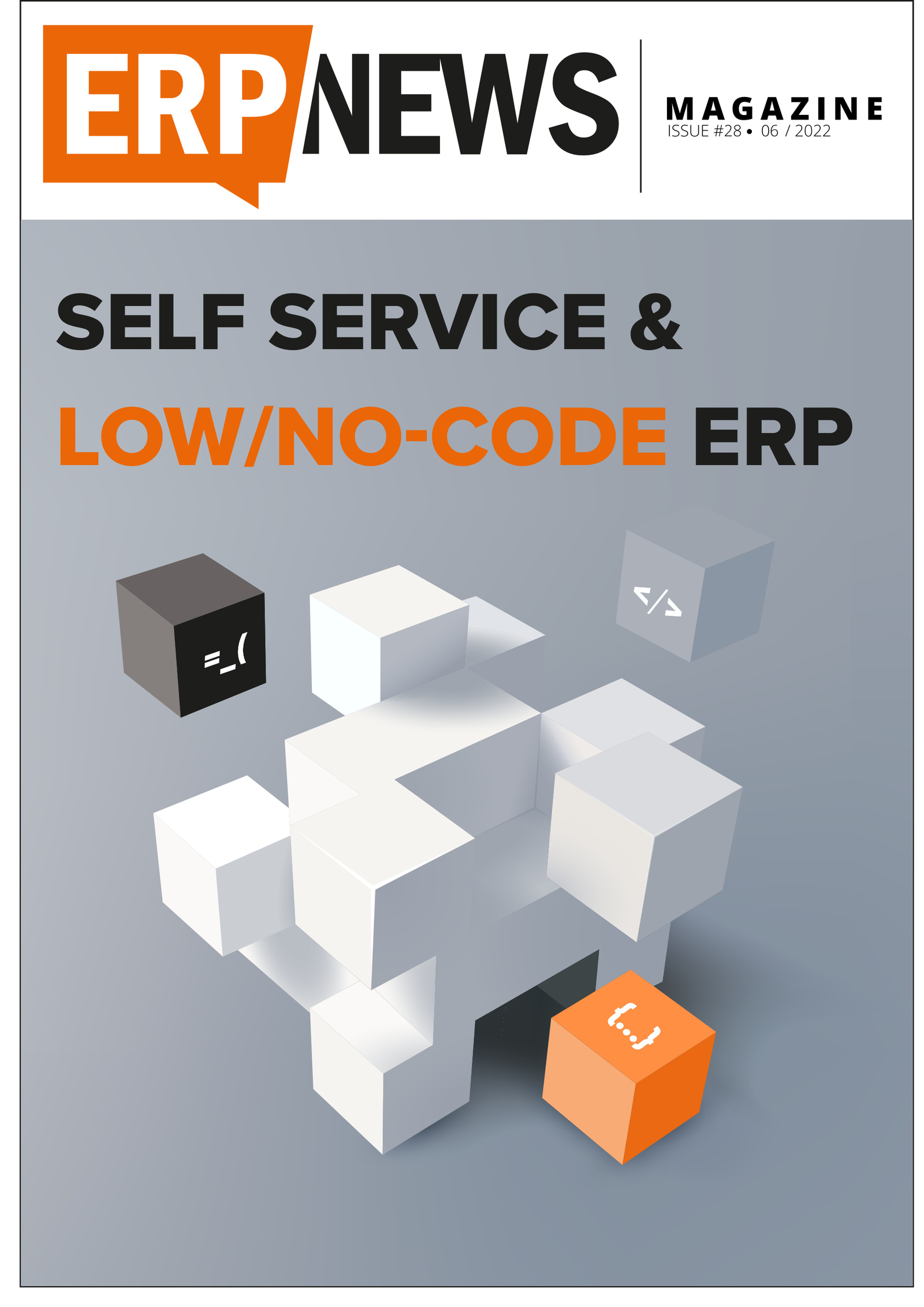
Self Service & Low/No-Code ERP
Explore how self-service and low-code tools reshape ERP development, with Unit4 and Pillir perspectives, an Avalara tax interview, finance and sustainability analysis, and customer transformation experiences.
About this issue
Extending ERP around the people who use it
How can organizations adapt ERP to their work without creating another layer of unmanaged complexity? ERP News Magazine Issue 28, June 2022, explores Self Service & Low/No-Code ERP through citizen development, modernization, finance, compliance and industry applications. The issue considers the speed and flexibility of new development tools alongside the data access, skills and controls required to use them effectively.
Citizen development and modernization
Claus Jepsen, Chief Technology Officer at Unit4, describes a shift toward applications designed around specific teams and micro-industry needs. Business users can contribute their understanding of work, while IT provides training, review, governance and a manageable development environment. APIs and loosely coupled services allow extensions to build on core enterprise information. His separate expert panel adds a caution: a simple interface does not remove the need to understand business logic, security and access to underlying data.
Vaidya Aiyer, CEO and Founder of Pillir, examines low-code development as a route for modernizing legacy ERP applications. His article considers the difficulty of moving long-lived custom code to cloud environments and proposes identifying useful functionality, reducing technical debt and generating applications that can evolve separately from the core.
The Pillir article includes several customer examples. Dole Packaged Foods uses mobile applications and low-code development in a modernization journey involving SAP ECC and S/4HANA; the article reports 30% cost savings without providing a detailed cost baseline. Brown-Forman uses low-code tools to replace manual processes and create adaptable applications, with qualitative benefits. An unnamed global oil-and-gas drilling contractor digitizes and mobilizes applications for environments with limited connectivity, reporting development time reduced from months to weeks. These examples are attributed to the contributor and have distinct scopes.
Darren Edwards, Head of Product Operations at SYSPRO, contributes an expert panel on manufacturing applications and labor pressures. He emphasizes that low-code tools must connect with ERP's central data to preserve operational visibility. This reinforces the issue's recurring point that ease of development and integration capability must be evaluated together.
Compliance, selection and operating models
David Lingerfelt, Senior Director of Tax Content at Avalara, discusses tax compliance for SaaS and software businesses. His interview examines economic and physical nexus, transaction information, exemption certificates, calculation and filing, and the challenge of determining where digital products are consumed. State rules, proposed sourcing approaches and emerging-product examples reflect the 2022 publication context; they are not presented as current tax instructions.
Lynne Jackson, Product Marketing Manager for General Business at Acumatica, outlines ERP selection through organizational support, functional priorities, budget, scalability and vendor relationships. Jim Reilly's Infor article complements this with total cost of ownership: licenses or subscriptions, implementation services, training, ongoing support, upgrades and security. Both encourage decisions based on the full operating commitment rather than an initial price alone.
Syntax's application-management overview considers short-term, hybrid and broader outsourced support for SAP environments. It discusses skills, response times, scalability and service models. FinancialForce's platform article argues for applications sharing a common foundation, using Salesforce as its example. Its no-integrations framing concerns that architectural context, rather than establishing that enterprise integration work can always be eliminated.
Finance, sustainability and supply-chain information
Prophix's article draws on Theodora (Theo) Lau, Founder of Unconventional Ventures, to examine AI in finance. She recommends starting with a clear business problem, addressing fragmented information, explaining models and validating outputs with people involved. Routine reporting and anomaly detection illustrate opportunities; AI remains an implemented capability that requires planning rather than a product switched on without preparation.
Olly Lukatski of Priority discusses AI-supported analytics, inventory decisions, customer experiences and assistants. Brent Dawkins, Director of Product Marketing at QAD, connects ERP with responsible sourcing, waste reduction and more efficient supply chains. His Ford example describes environmental targets, not savings demonstrated by a QAD implementation.
SYSPRO's research article reports a late-2021 survey of 163 manufacturing and distribution professionals across EMEA, the Americas and APAC. It contrasts investment in internal systems with limited external collaboration and analytics, arguing for digital roadmaps that include suppliers and customers. These are findings from the surveyed group, not proof of a universal causal relationship.
Customer experiences and industry developments
MPOWERD replaces Salesforce and other disconnected solutions with Oracle NetSuite to unify financial operations. The company reports an almost 70% reduction in time to close its books and a move from monthly to daily reporting. Shared data also supports remote work and cross-functional collaboration. Further supply-chain, inventory and aid-distribution applications remain exploratory. The company's broader social and environmental impact figures describe its mission, not outcomes attributable to ERP.
Ducati chooses RISE with SAP for a business transformation, with planned SAP Commerce Cloud and Integrated Business Planning deployments. Supplier collaboration, customer experience and supply-chain responsiveness are objectives. The announcement also includes SAP's MotoGP team partnership, but provides no measured completed transformation savings.
Nowy Styl selects an upgrade to IFS Cloud to support international growth and incremental capability expansion. Manufacturing scheduling, MES information flows and later shipping automation feature in its plans; CRM is being assessed. Existing IFS use and integration of acquired entities form background, while the latest upgrade's benefits remain prospective.
Product news includes Sage Intacct 2022 Release 2, covering evergreen subscription billing, inventory fulfillment and construction contracts. Availability differs by feature and region. Sage's channel study places technical skills and workforce development alongside cloud and analytics demand, while Epicor's Nucleus Research recognition concerns its SMB ERP portfolio and functionality/usability positioning.
Acquisition coverage includes Oracle's Cerner regulatory approval announcement, Unit4's Scanmarket agreement and ServiceNow's planned Hitch Works acquisition. These stories connect healthcare information, strategic procurement and skills intelligence with broader enterprise-platform strategies, retaining the transaction stages described in the source.
Across the issue, self-service ERP depends on more than reducing the amount of code written. The contributions connect business knowledge, reliable information, operating support and disciplined governance with the ability to adapt enterprise systems over time.
Read Issue 28 Online
The magazine is loaded directly from ERP News servers.