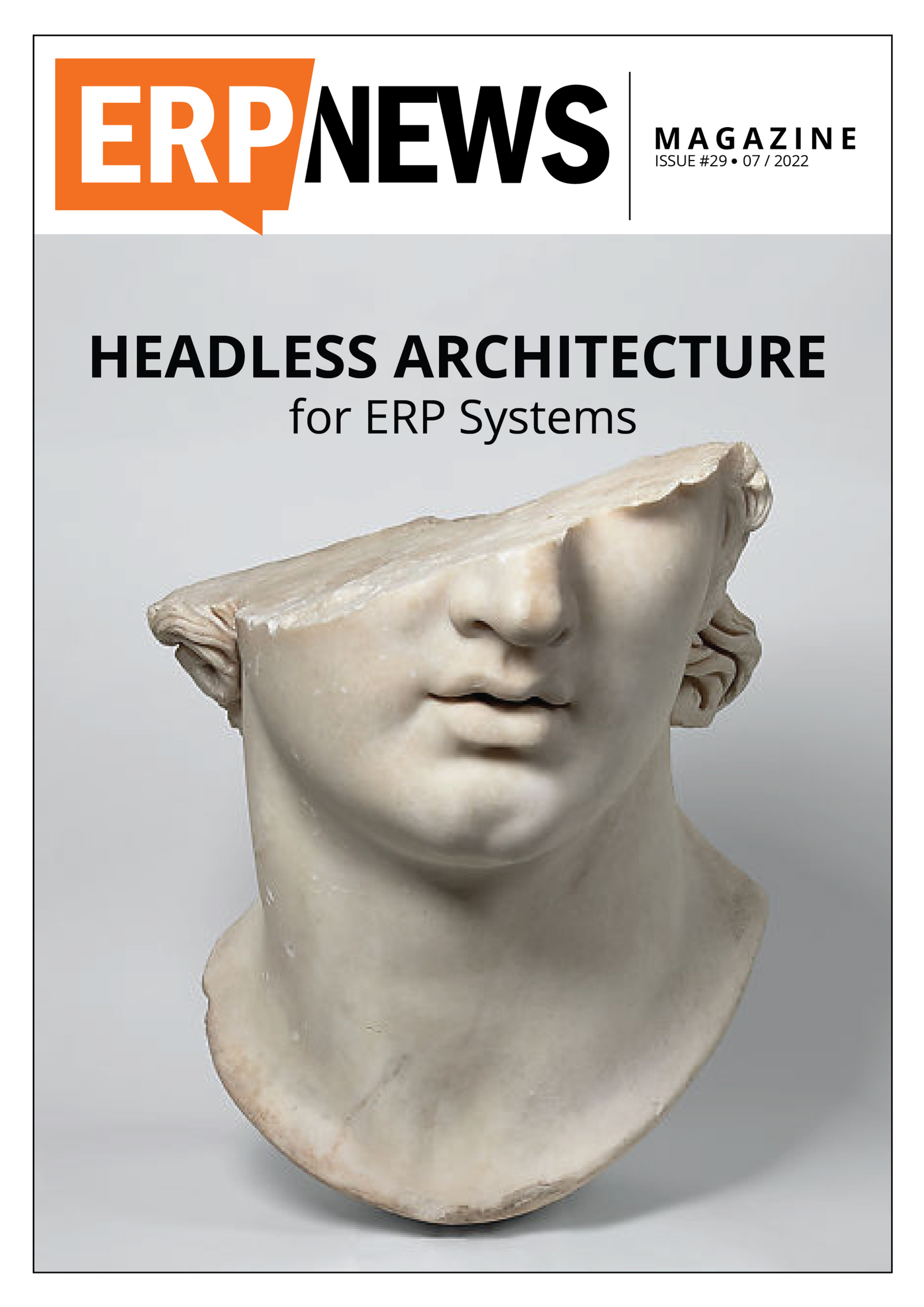
Headless Architecture for ERP Systems
Explore headless ERP through API-based experiences, automated data capture and business fit, with SirionLabs, Unit4, EGPAF and Syntax interviews, customer experiences and manufacturing quality insights.
About this issue
Connecting ERP with new ways of working
Can organizations change their digital experiences without rebuilding the systems that support them? ERP News Magazine Issue 29, July 2022, explores Headless Architecture for ERP Systems through digital sales, manufacturing integration, contracts and people-centered operations. Its contributors use headless ERP in related but distinct ways: separating task-specific interfaces from the back end, and moving operational data into ERP without repeated manual entry.
Architecture, automation and business fit
John Froelich, Senior VP of Digital Services at Bramasol, examines API-connected interfaces for digital sales and subscription-oriented businesses. He argues that independent experiences can reduce the burden of maintaining custom extensions inside the ERP core. His discussion connects customer engagement, orders, fulfillment, billing and revenue processes, while presenting lower cost and reduced lock-in as potential architectural benefits rather than measured universal outcomes.
Edward Talerico, Senior Product Director for Infor LN Industry CloudSuites, approaches headless ERP from manufacturing. Machines, sensors and APIs can replace manual transfers and help businesses interpret growing volumes of operational data. An unnamed electronics manufacturer illustrates a highly automated factory with fewer than 50 on-site employees. Another unnamed pump-and-valve manufacturer uses sensor information to identify maintenance and replacement-parts opportunities. These examples have distinct scopes, and the article does not establish a common ROI benchmark.
Biju George, SVP of Oracle Practice at Syntax, discusses when out-of-the-box ERP is appropriate and when more complex requirements justify extensions. His interview emphasizes business objectives, the value of existing systems, robotic process automation, integration modernization and managed support. A resource-forecasting tool developed with customers illustrates targeted enhancement; the customers are not identified and no numerical outcome is supplied.
Contracts and people-centered organizations
Puneet Bhakri, Senior Vice President of Global Alliances and Partnerships at SirionLabs, explains how SirionOne connects contract authoring, approval, analysis and performance management. His interview highlights obligations, service levels and the relationship between pre-signature work and post-signature experience. He also describes the KPMG Germany alliance and expansion across the DACH region. Reported customer cost reductions remain attributed interview claims, while reverse contracting and broader enterprise insight form part of his future vision.
The issue's joint Unit4 and Elizabeth Glaser Pediatric AIDS Foundation interview brings vendor and customer priorities together. Dave Dyer, Regional President of North America at Unit4, discusses ERP designed for project-based, people-centered organizations, including nonprofits. He links composability, industry-specific data flows and integration with greater adaptability.
Craig Molyneaux, Chief Operating Officer at EGPAF, explains why disparate applications no longer met the foundation's reporting, donor and operational requirements. Unit4 ERPx is selected to support integrated planning, project and grant budgets, transparency and more consistent processes. Molyneaux explicitly describes benefits expected once deployed; the interview does not report a completed rollout or measured administrative savings. EGPAF's public-health reach provides mission context, rather than an ERP-attributable outcome.
Customer experiences and transformation plans
FishUSA replaces QuickBooks and other legacy software with Oracle NetSuite to connect finance, inventory, CRM and e-commerce. David Rodman's article describes clearer financial visibility and more manageable reporting obligations. The retailer reports reducing its financial close from three weeks to one week. That achieved result is specific to this customer and should remain separate from possible future expansion into products and markets.
Deichmann's HR digitization combines SAP SuccessFactors with SAP Business Technology Platform and implementation partner ROOS IT. The account by Johannes Klostermeier describes digital pay statements, mobile access and employee self-service. Pay statements have reached 1,200 employees at headquarters and around Essen; retail outlets and further functions are still to follow. The article discusses lower printing and postage needs without quantifying savings or claiming a completed global rollout.
Nordic Paper decides to upgrade its on-premises enterprise asset management environment to IFS Cloud with partner Novacura. Maintenance, finance and procurement support a platform serving approximately 400 users. Improved security, uptime and operational efficiency are objectives of the upgrade announcement, without measured post-upgrade results.
Capgemini extends its work on Mercedes-Benz's big-data platform for automated-driving development, testing and validation. The company describes operating the platform at three sites in Germany and the United States, with further development and round-the-clock support. This is an automotive data-engineering engagement, not a Mercedes-Benz ERP implementation or proof of deployed driverless vehicles.
20/20 Plumbing & Heating signs a five-year Nextworld agreement spanning financials, procurement, warehousing, projects, manufacturing and construction, together with the Nextbot no-code platform. Executives describe expected business-process flexibility and scalability. The announcement supplies no completed implementation results.
Lehigh Valley Health Network selects Workday finance, HCM, sourcing, supply-chain and analytics applications for its digital-health strategy. Intended benefits include connected workforce and financial information, inventory visibility and improved planning. The selection announcement does not establish realized cost savings or a clinical improvement caused by the platform.
NTT DATA and SAP introduce Connected Product for monitoring sensitive shipments and supporting insurance processes. An unnamed Spanish logistics group and German insurer participate in a pilot involving hundreds of containers and 20 shippers between Europe and Asia. The pilot continues through September 2022 in the source; broader operational adoption remains planned.
Manufacturing quality and industry developments
Jim Steventon's QAD article, co-written with Senior Product Manager Brian Brooks, explains why FMEA software should connect with control plans, corrective action, training and document changes. It discusses foundational templates and linked quality information in the context of Ford's customer-specific requirements, rather than presenting FMEA as an isolated spreadsheet exercise.
News also covers Acumatica's phased Shopify B2B integration, Deltek's agreement to acquire TIP Technologies, ECI's Paperless Parts alliance and FinancialForce's workplace awards. Allied Analytics contributes a historical ERP-market forecast, which remains a projection from the publication period.
Across its contributions, the issue frames ERP modernization around connected experiences, reliable data flows and requirements that reflect how an organization operates. Architecture becomes useful when it supports those priorities without obscuring implementation effort, governance or the distinction between ambitions and results.
Read Issue 29 Online
The magazine is loaded directly from ERP News servers.