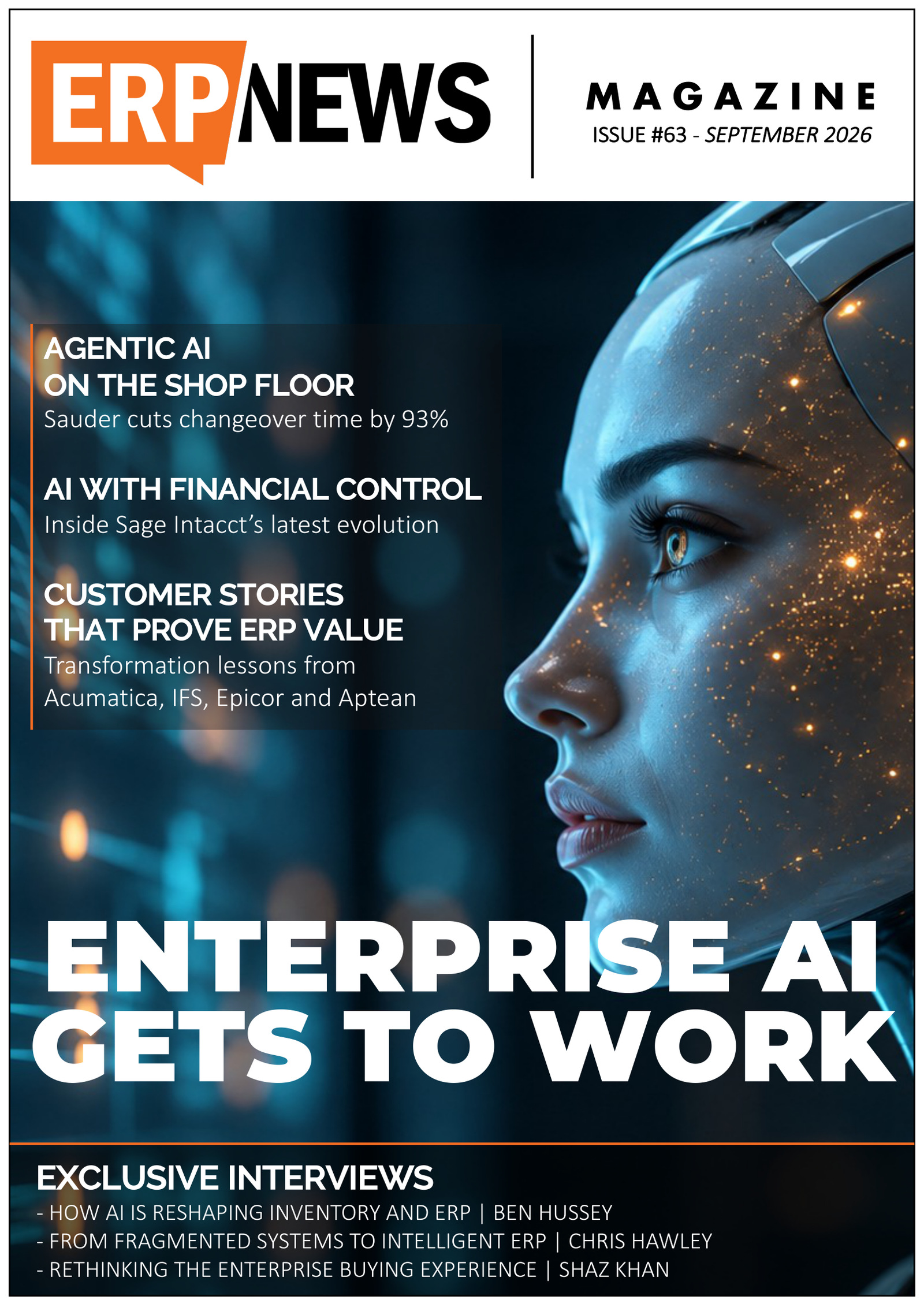
Impacts of Artificial Intelligence in ERP
Explore how AI changes ERP, finance and manufacturing through expert perspectives from Infor, Acumatica, Sage and others, alongside intelligent-factory analysis, product news and customer transformation plans.
About this issue
Making AI useful across the enterprise
How can organizations turn AI's promise into practical improvements in ERP and everyday work? ERP News Magazine Issue 31 explores Impacts of Artificial Intelligence in ERP through expert articles, manufacturing analysis, finance automation, product developments and customer announcements. September 2022 is used here from the cover; the contents instead says August 2022, a source inconsistency documented in the accompanying editorial notes.
Expert perspectives on readiness and decision-making
Natalie M. Gibson, Senior Director, Strategy and Go-to-Market at Infor, argues that successful AI requires organizational preparation. Her guidance covers a shared vision, cross-functional teams, realistic scope, connected information and ongoing maintenance. Starting with a meaningful problem and usable data is more practical than pursuing isolated experiments without an operating model for production.
Lucy Thorpe, Head of Communications at Sapphire Systems, examines AI through routine-process automation, predictive maintenance and better-informed decisions. She cautions against imagining a system that can run the company independently. Ali Jani, Chief Product Officer at Acumatica, distinguishes interactive advice, intelligent retrospective advice and zero-touch automation. His article emphasizes the time and persistence required to develop useful capabilities, rather than assuming that AI always outperforms people.
Aaron Harris, CTO at Sage, sets out a finance vision built around continuous accounting, assurance and insight. Transaction capture, reconciliation, adjustments, anomaly detection and forecasting could reduce the limitations of periodic reporting. An unnamed paving-stone business illustrates how trust can be a barrier even when automation is available. Harris also describes forecasting work in which combining machine learning with human-informed models improved results; his broader continuous-finance framework remains a strategic direction rather than proof that the close has disappeared everywhere.
A contribution from Claus Jepsen, CTO at Unit4, reinforces the importance of business objectives and data quality. Receipt recognition, invoice processing and timesheets illustrate possible applications. His expectation that up to 80% of routine processes could be automated is a forecast from the publication period, not a measured adoption result.
Intelligent manufacturing and operational integration
Daniel Carranco, Director of Continuous Improvement at Global Shop Solutions, organizes manufacturing automation around labor costs, waste, turnaround, quality and safety, and future readiness. He connects investment decisions with operational strategy and measurable returns. FANUC appears as an illustrative robotics example, rather than a documented Global Shop Solutions deployment.
Kiran Bajpai's article, presented with OptiProERP, examines pattern recognition, repetitive work, proactive maintenance, customer service and departmental integration. Olly Lukatski, Global Marketing Communications and Content Strategy Manager at Priority, discusses analytics, inventory decisions and user experiences. Panorama Consulting Group extends the discussion to forecasting, accounting, HR and service. These contributions describe potential applications rather than independently verified performance guarantees.
Raymond Russ of Fujitsu explains modern ERP as an integration foundation for IT/OT information, sensors, analytics and secure APIs, with SAP as a technology partner. Susan Galer's SAP article draws on Mike Lackey's manufacturing perspective to examine connected factories, individualized products and service-based business models. Analyst adoption and performance figures in the article are historical predictions, not results established by this issue.
Finance, security and technology developments
Rom Hendler, CEO and Co-Founder of Trustifi, discusses automated email screening and encryption in a compliance context. The article presents a vendor's approach to reducing manual intervention; it does not establish that software alone guarantees compliance or removes the need for organizational controls.
Auditoria announces AP and AR Helpdesk SmartBots for shared finance inboxes, including categorization, conversational replies, worklists and escalation. CADTALK and QAD announce engineering-to-manufacturing integration for bills of material and routings. SirionLabs expands its KPMG alliance around contract lifecycle management, while 3i Infotech describes incubating Campus Labs and developing NuRe Campus for education administration.
Further news covers Deltek's first year with ArchiSnapper, SAP SuccessFactors talent-development capabilities, NTT DATA's agreement to acquire Apisero, and Salesforce Genie. Salesforce's announcement connects unified customer profiles with Einstein, Flow and integrations involving Snowflake and Amazon SageMaker. Availability and transaction status are retained as described in the source.
Customer examples and transformation plans
Hitachi Zosen Inova selects IFS Cloud to replace a fragmented application landscape and support its project lifecycle, from bidding and engineering to construction and services. Arcwide is to support a rollout across 13 countries. Operational visibility and efficiency are intended benefits, without completed implementation savings.
Coflex selects Infor WMS with partner Cerca Technology to improve inventory control, product tracking, warehouse productivity and service. Although the release refers to the partner selling and implementing the solution, most benefits are framed as project goals. It provides no measured inventory-accuracy or delivery improvement.
DRB-HICOM chooses Prophix for consolidation and reporting across its multinational group. Web-based submissions, validation, currency translation and automated calculations are intended to reduce duplication and reporting delays. The announcement describes a future implementation and does not quantify realized time savings.
Within Deltek's announcement, Whitecode Consulting selects Vantagepoint and ArchiSnapper. Managing Director and Owner Alex Hill anticipates better-managed services and growth; the article supplies no completed customer ROI. ArchiSnapper's reported revenue and trial-growth figures describe the product business, not Whitecode's results.
Salesforce's customer examples have similarly distinct scopes. Ford describes Marketing Cloud and CDP as a shared information foundation connecting customer touchpoints; no quantified Genie-specific outcome is supplied.
L'Oréal describes connected online and offline engagement using Salesforce marketing, personalization, commerce and service products. The example concerns customer experience across channels, without a measured return attributed to the new platform.
Formula 1 describes using Salesforce to consolidate fan information and deepen engagement through AI and automation. Its audience figures provide organizational context rather than evidence of growth caused by Genie.
PGA TOUR Superstore describes more controlled, relevant messaging across channels as its audience broadens. The statement is qualitative and should not be converted into a sales-lift or conversion claim.
Across these varied contributions, the issue grounds intelligent ERP in connected data, clearly chosen use cases and sustained human involvement. The technology's promise depends on the ability to deploy, maintain and evaluate it in the context of real work.
Read Issue 31 Online
The magazine is loaded directly from ERP News servers.