ERP Automation: Benefits and Trends
Explore how intelligent ERP automation connects manufacturing, finance and people, with Infor and Acumatica interviews, low-code perspectives and customer experiences across retail, industry and public services.
About this issue
Turning automation into operational value
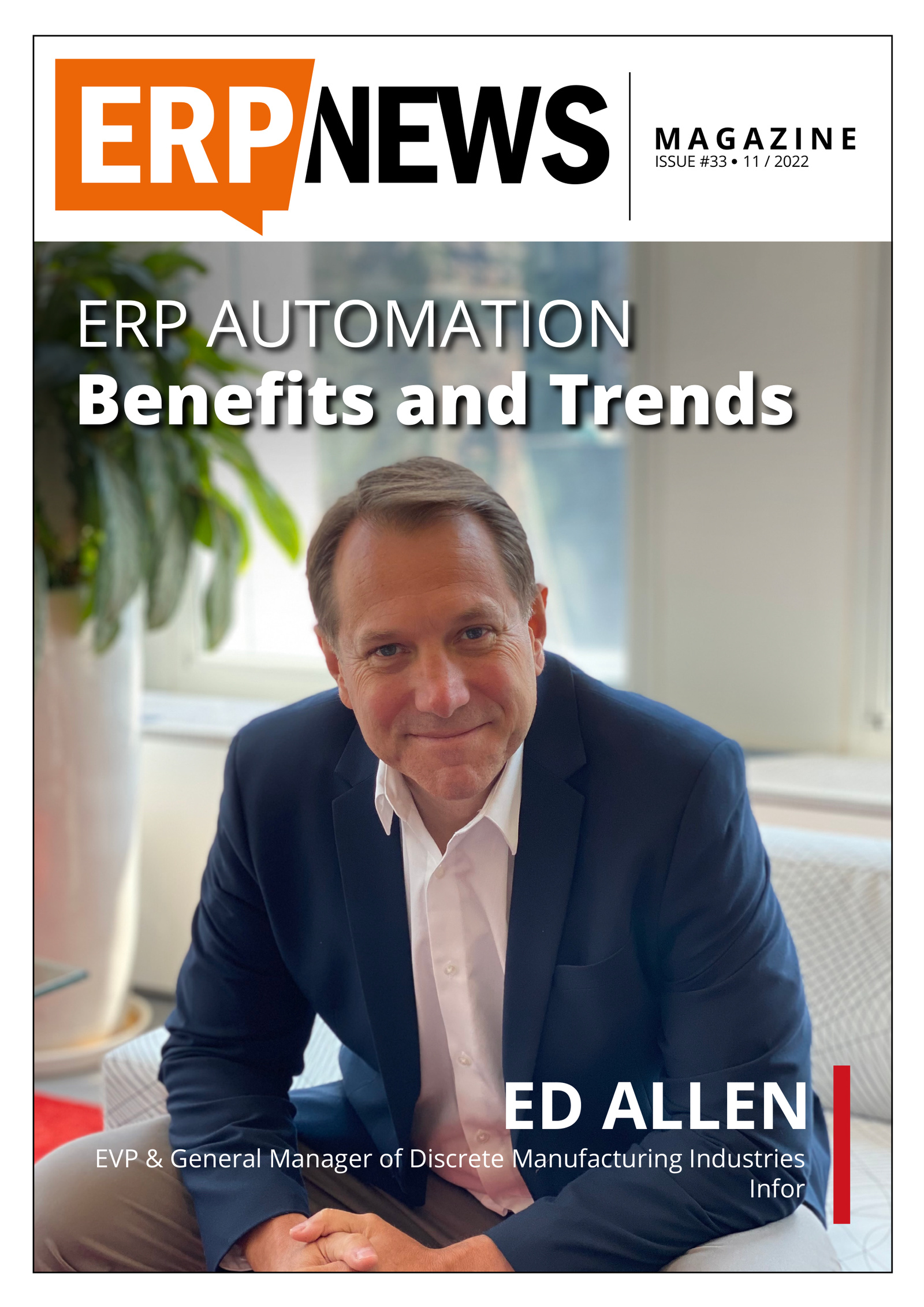
How can ERP automation improve the work people do and the decisions they make? ERP News Magazine Issue 33, November 2022, explores that question through manufacturing leadership, finance workflows, low-code development, security and customer experiences. Its central concern is how organizations connect information and processes while preserving the expertise needed to interpret exceptions, manage change and deliver reliable services.
Executive perspectives
Cover interviewee Ed Allen, EVP and General Manager of Discrete Manufacturing Industries at Infor, describes automation spanning ERP, manufacturing execution, analytics and machine learning. He emphasizes industry-specific data structures, embedded capabilities and a composable platform. Infor OS provides the foundation for integration, productivity and automation, including capabilities offered to customers still using on-premises ERP. Predictive maintenance, production-quality monitoring, finance approvals and service planning illustrate potential applications. Allen also explains why servitization requires different commercial models and information about products operating in the field.
CJ Boguszewski, Vice President of Partner Strategy and Programs at Acumatica, discusses the company's Services Partner Program. Specialist partners supplement value-added resellers and independent software vendors with implementation, configuration, development and consulting expertise. The interview connects automation with human relationships and industry knowledge. Boguszewski argues that decision support and forecasting depend on both the platform's architecture and the ecosystem helping customers apply it. Key Code Media appears as an embedded example, with a reported 70% revenue increase since adopting Acumatica; the interview does not isolate automation as the sole cause.
Analysis, finance and process design
Allan Lessing, Director of Customer Solutions at OptiProERP, examines AI, machine connectivity, supply-chain visibility and more personalized user experiences. His outlook includes industry-specific systems, cloud adoption, two-tier ERP and a growing role for intelligent automation. Mark Wheeler, Director of Automation and AI at Sapphire Systems, frames five benefits around releasing skilled staff from low-value work, creating capacity, connecting systems, accelerating insight and changing organizational culture. His scenarios illustrate possibilities rather than measured customer results.
Wayne Slater, Director of Product Marketing at Prophix, explains how integrating ERP with corporate performance management can support budgeting, forecasting, scenario modeling and reporting. Vaidya Aiyer, CEO and Founder of Pillir, proposes combining process mining, robotic process automation and low-code/no-code development to identify inefficiencies and fill gaps across enterprise workflows. Panorama Consulting Group supplies a complementary implementation guide: define functional areas and responsibilities, document processes, identify repetition and prioritize improvements within a wider transformation.
Katie Slimov's product review examines Auditoria SmartBots for AP and AR inboxes, including conversational responses, mailbox organization, prioritized worklists and escalation to finance staff. Brian Wasson's SAP review introduces SAP Build, bringing application creation, process automation and business sites together with governance on SAP Business Technology Platform. SAP's Coursera partnership and developer-upskilling commitments are announcements and targets from the issue's publication period. George Ploss, Director of NetSuite Accelerator, describes expansion through partners supporting entrepreneurs from underserved communities.
Customer experiences and implementation plans
Riot selects Oracle NetSuite to consolidate operational and financial information as its Bitcoin-mining business expands. Sam Levy's customer story links the selection to planning, internal controls and supply-chain visibility. The described benefits are intended outcomes, without completed rollout savings or a measured productivity improvement.
Saddleback Leather's Acumatica story reports a move away from its previous ERP environment with implementation support from Kensium. Founder Dave Munson describes improved inventory visibility, shared financial information and easier e-commerce connections. He reports 45% higher organic traffic and approximately $750,000 in annual savings associated with reducing the development team. These are attributed customer statements; differing technology-cost comparisons in the article should not be combined into a single verified savings percentage.
Swedish agricultural-equipment manufacturer Väderstad purchases IFS Cloud to replace five ERP systems and support engineering, service, assets and order-to-delivery processes. The announcement plans a phased rollout for 2,000 users across 18 sites in 17 countries. Its efficiency and growth benefits remain prospective.
Babergh and Mid Suffolk District Councils select Unit4 ERP for shared finance and procurement services. Their objectives include fewer spreadsheet-based tasks, self-service reporting, auditability and stronger controls. The issue presents a selection announcement, rather than quantified post-implementation results.
Carrs Tool Steels uses Priority ERP, with support from Medatech, to replace paper-led processes and improve operational visibility. Customized production routes support processing-based quotations, pricing and delivery commitments. The story also describes remote access during the pandemic and adaptation to supply-chain disruption, with qualitative operational benefits rather than a quantified return.
Resilience, supply networks and industry developments
Adam Mommersteeg, VP of Solution Architecture at Protera, discusses coordinated disaster-recovery automation, repeatable tests and the sequencing of applications, data and responsibilities. Rom Hendler, CEO and Co-Founder of Trustifi, considers email-security automation, encryption, layered protection and staff training. Both contributions address operational resilience; they do not establish guaranteed protection or universal cost savings.
Rootstock's Fall '22 announcement and Stu Johnson's accompanying article examine supplier RFQs, alternative sourcing, dashboards and collaboration through Salesforce Experience Cloud and Slack. The announcement specifies limited release to selected discrete manufacturers. SAP's Industry 4.0 Pop-Up Factory illustrates connected product-lifecycle processes through working demonstrations.
Yves de Beauregard's Fujitsu article advocates modular computer vision for quality assurance. GKN Aerospace is named, while infrastructure, supermarket and packaging examples remain unnamed. The packaging example describes more precise particle detection and less reliance on chemical cleaning; no customer identity or numerical savings are supplied.
News also covers QAD DSCP 2022.1, Epicor's building-supply portfolio, NTMA recognition for Global Shop Solutions employees and NTT DATA's fourth consecutive Azure Expert MSP designation. Unit4 research on flexible work and Sage research on HR workloads connect technology investment with workforce experience. Together, the contributions place ERP automation within a broader discipline of sound process design, reliable information and supported people.
Read Issue 33 Online
The magazine is loaded directly from ERP News servers.