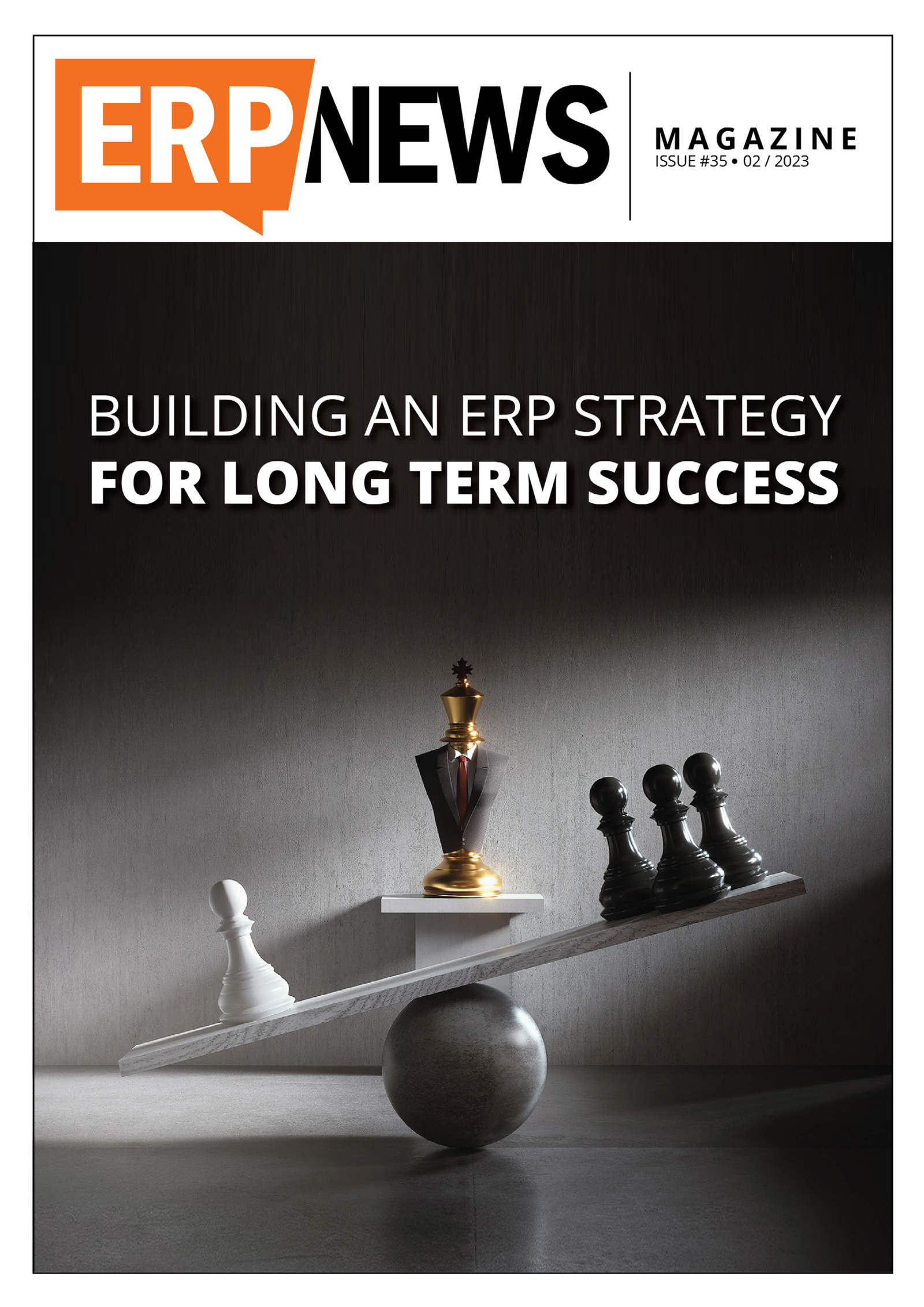
Building an ERP Strategy for Long Term Success
Explore how business outcomes, composable platforms, data and workforce skills shape a lasting ERP strategy, with Auditoria's Adina Simu, practical implementation guidance and customer experiences from Kodak Alaris, Fill and the UK's EV grant service.
About this issue
Planning for value beyond go-live
What makes an ERP strategy useful after the implementation team has left? ERP News Magazine Issue 35, February 2023, explores long-term success through business alignment, composable platforms, finance automation and organizational readiness. Its central argument is that new software alone cannot produce the intended outcomes. Clear objectives, reliable information, governance and continuing investment in people must shape both the initial project and the platform's future development.
Finance automation with a purpose
Adina Simu, Chief Product and Commercial Officer at Auditoria, discusses how intelligent automation can reduce repetitive work across accounts payable, receivable, general accounting and vendor management. Her examples focus on shared inboxes, payment-status questions, incoming documents, collections and accrual information. Natural language technology, computer vision and knowledge graphs connect communications with the finance processes behind them.
Simu's selection criteria include compatibility with existing systems, understanding of finance-specific work, decision support and a purpose-built approach. She connects automation with more engaging work for finance professionals rather than simply removing positions. Large-language-model enhancements to AP and AR Helpdesk SmartBots and further analytics appear as a 2023 product direction; the interview does not establish a quantified customer result for every capability described.
Strategy, composability and business resilience
Mike Guay, Vice President Customer Success at Infor, argues that composable ERP strategies must accommodate new applications, decentralized development and changing user experiences. Outcomes should be measurable, and governance should allow organizations to adopt useful capabilities within their risk tolerance. Workforce development extends beyond technical skills to process evaluation, change management and advisory roles. His recommendation to review the strategy regularly makes it a continuing management process.
Lucy Thorpe, Head of Communications at Sapphire Systems, links ERP strategy with resilience under economic and supply chain pressure. Both her article and a separate executive perspective advocate beginning with business outcomes and considering digital capabilities beyond the core ERP. Unit4 CTO Claus Jepsen similarly emphasizes understanding existing processes, deciding what to replace or integrate, and maintaining a clear vision before and after implementation.
Nathan Williams, Practice Director for Development and Innovation at NIMBL, considers how organizations can use SAP BTP credits within a RISE with SAP context. Integration, data management, analytics and low-code development offer opportunities, but realizing value requires suitable expertise and a plan. The contribution discusses using partner support where internal capabilities are limited, without promising a universal financial return.
Building an implementation that can endure
Allan Lessing, Director of Customer Solutions at OptiProERP, sets out practical selection and implementation requirements. A credible cross-functional team needs management support, time and clear responsibilities. Requirements and KPIs should connect with business goals, while communication, clean migration data and progressively integrated testing reduce avoidable problems. The article distinguishes steering, project-management and core-team roles.
Mike Melzer, VP of Operations and Service at Global Shop Solutions, develops eight connected manufacturing priorities: flow, scheduling, costs, inventory, labor, quality, customer service and sales. The article links production data with planning and commercial decisions. Deloitte's closing contribution brings the issue back to finance fundamentals: vision, functional integration, reporting, chart of accounts, data strategy and talent must precede expectations of transformation.
Customer stories: simplification and adoption
Kodak Alaris modernizes from Dynamics AX 2012 to Microsoft Dynamics 365 following a structured evaluation. A simplification team requires justification for customizations, while conference-room pilots, migration tests and cutover rehearsal support a worldwide launch on July 18, 2022, involving more than 700 users. The story reports 45% fewer customizations and 25% fewer independent-software-vendor components, alongside more resilient reporting using Azure data services and Power BI. An approximately 25% cost reduction is projected rather than presented as a fully realized saving.
Fill replaces an unreliable custom analytics environment with Infor Birst, supported by Solicon IT. Familiar reporting layouts and staged implementation help rebuild confidence and extend use across sales, service, purchasing and project teams. The customer reports a 400% rise in analytics adoption, at least 40 hours saved weekly in manual data management and a 5–10% increase in back-office productivity. These are separate reported measures; the adoption figure does not mean manufacturing output increased by 400%.
The UK's Office for Zero Emission Vehicles works with Capgemini to digitize residential EV chargepoint grant applications. User research includes residents, landlords, installers and administrative staff. A portal on Google Cloud connects with a Microsoft Dynamics processing platform, bringing eligibility checks, application records and installation evidence into a coordinated service. Launched in August 2022, the service is reported to speed processing and payments and reduce administration, without a published numerical efficiency improvement.
Lumenia's paperless-validation article adds an unnamed biotechnology customer's experience with SAP S/4HANA. A specialist electronic-validation system supports document approvals, requirements traceability, test evidence and audit trails. The author acknowledges setup effort and licensing costs, while deliberately withholding both the customer and validation-product identities. The account describes process improvements rather than a quantified ROI.
Finance, people and platform choices
Prophix CEO Alok Ajmera's finance outlook prioritizes cash forecasting, covenant monitoring, currency exposure and stronger data foundations. Nolan Business Solutions reviews expected NetSuite 2023.1 capabilities and release-preview testing. Anirudh Bhardwaj's Oodles ERP contribution presents an argument for open-source ERP, including customization and integration; implementation and support still require resources.
Bret Tushaus, Vice President of Product Management at Deltek, examines eight priorities for project-based firms, from talent and connected systems to user experience, security and project-management tools. Jessica Fuhl, Head of Content at Sage People, explores HR workload, strategic influence, skills and technology through survey findings. The HR article contains 2024 references and differing percentages within this February 2023 source, which are documented separately rather than used to change the issue date.
Industry developments and continuing strategy
News covers Unit4 Marketplace, EZO's rebranding and CMMS launch, Nulogy Connect, Lumenia's ERP Head to Head event and Acumatica Summit's customer-rights discussion. Microsoft outlines Dynamics 365 and Power Platform release-wave plans and its expanded OpenAI partnership. SAP announces BMW Group's RISE decision, Rootstock names Geoff Brannon CFO, Accenture invests in Forma Vision, and Capgemini reports on public-sector data sharing.
Together, the contributions show why ERP strategy must remain active. Integration choices, application extensions and emerging AI capabilities create possibilities, while the customer experiences demonstrate the importance of simplification, trustworthy data and usable processes. Lasting value depends on connecting those possibilities with the organization's priorities and its capacity to sustain change.
Read Issue 35 Online
The magazine is loaded directly from ERP News servers.