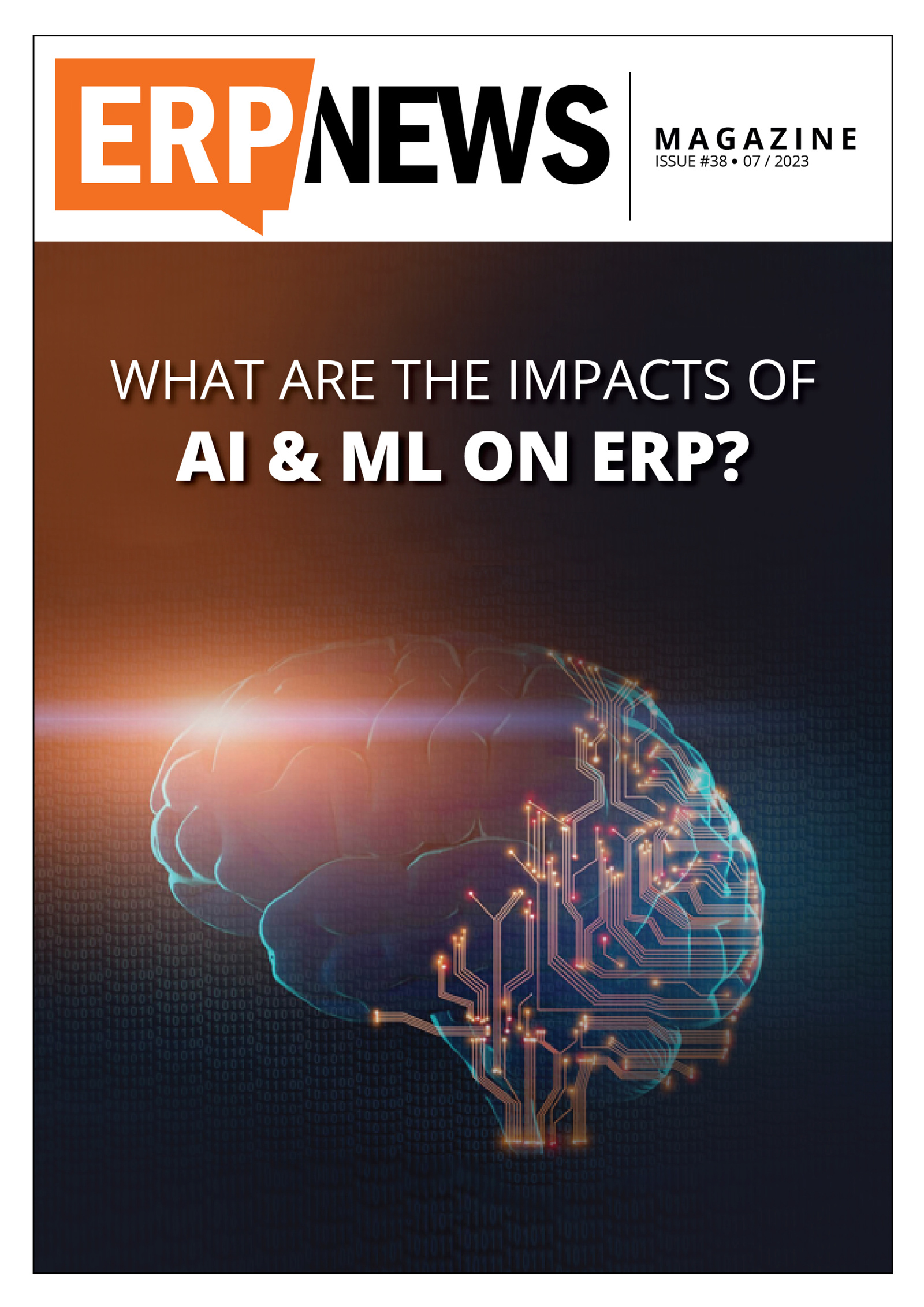
What Are the Impacts of AI & ML on ERP?
Explore how artificial intelligence and machine learning reshape ERP decisions, automation and service delivery, with perspectives from Certinia, TriVista and Unit4 and customer experiences across manufacturing, distribution and IT services.
About this issue
Building the foundations for intelligent ERP
What must businesses put in place before artificial intelligence can improve their enterprise systems? ERP News Magazine Issue 38, July 2023, examines the impact of AI and machine learning on ERP through executive interviews, practical analysis, customer stories and industry announcements. Forecasting, resource allocation, maintenance and customer service offer opportunities, but the issue repeatedly returns to reliable data, implementation ownership and employee development as foundations for useful automation.
Executive perspectives on services and transformation
Andy Campbell, Global Solution Evangelist at Certinia, explains the company's transition from FinancialForce to a broader Services-as-a-Business platform. Connected operations, accessible intelligence and business agility underpin his argument. Built on Salesforce, the platform links customer, operational and financial information. Campbell discusses intelligent staffing as a practical AI application, while emphasizing that dependable shared data must come before ambitious automation. The rebranding reflects a portfolio extending beyond accounting into professional services, planning and customer success.
James Bandy, Principal and Head of Digital and Technology Practice at TriVista, recommends a staged roadmap for small and middle-market organizations. Budgets, clear goals and an accountable change leader precede technology selection. His pyramid places ERP and core data at the base, AI-assisted insight above it, and informed action at the top. Predictive maintenance and automation of repetitive work illustrate possible applications; they are examples of potential value rather than measured outcomes at a named customer.
Bryce Wolf, Senior Manager of Industry Solutions at Unit4, examines professional services growth using a PAC study of 400 executives in Europe and the US. Respondents report project-delivery and utilization challenges, while many expect headcount and profitability to increase. Wolf connects improvement with integrated project and workforce management, employee education and small initial AI deployments. A separate contribution from Unit4 CEO Mike Ettling frames automation as a way to make room for more strategic work.
Turning data into operational decisions
George Yankovich, Director of Customer Engagement at OptiProERP, surveys AI applications in forecasting, inventory, maintenance, process automation and personalized service. He also identifies data quality, privacy, bias and skills as constraints. John Davis, CTO at Global Shop Solutions, develops ten manufacturing applications, from quality inspection and pricing to labor planning and autonomous production. These articles describe capabilities and possibilities, rather than guaranteed implementation results.
Mona Patel, Director of Product Strategy at Infor, focuses on bringing contextual insights to nontechnical ERP users. Her Combilift example shows AI-generated parts recommendations within the parts estimator, helping staff produce more consistent service quotations. The account highlights access to specialist data-science support and continued model maintenance. It does not quantify a reduction in repeat visits or claim that every service job achieves a first-time fix.
Glenn Graney, Marketing Director for Industrial and High Tech at QAD, considers connected workers as a collaborative workforce. Shared knowledge and daily interaction support training and adaptability alongside machine connectivity. QAD's Stephen Dombroski examines ERP selection through cloud delivery, scalability, traceability, global finance, supply chain planning and process flexibility. His argument connects present requirements with the organization's future direction.
People, governance and implementation
Kerrie Jordan, Epicor's Vice President of Product Management, Data Platform, distinguishes automation within ERP from automation across the wider business. She places training, employee control and continuing vendor support at the center of adoption. Forterro's contribution considers who should lead an ERP rollout, arguing for a capable champion supported by executives and departmental leads rather than isolated ownership by one function.
Martin Metcalf, CEO at Basis Technologies, argues that SAP changes should be planned using empirical information, timely visibility and appropriate resource allocation. Timo Schuette, Global Vice President SAP Product Learning CoE at SAP, examines low-code/no-code training and the distinct business knowledge citizen developers contribute. Such employees complement specialist developers and need deliberate learning opportunities.
Sage business writer Asavin Wattanajantra presents seven steps for generative AI adoption, covering customer needs, data, trust, creativity, feasibility, incremental deployment and continued learning. Salesforce's Eric Loeb, Executive Vice President of Government Affairs, advocates risk-based AI regulation. These historical contributions discuss governance choices and policy proposals; they do not establish current legal requirements. Plex's OEE article connects availability, performance and quality with machine data and manufacturing execution systems.
Customer experiences with connected platforms
Feetures replaces QuickBooks and FishBowl with NetSuite and uses NetSuite Analytics Warehouse to combine operational and commercial data. Connections with Shopify and other sources support demand analysis across multiple sales channels. NetSuite Planning and Budgeting remains under exploration in the account, distinct from the tools already implemented.
Morgan Motor Company goes live with IFS Cloud, supporting 160 users across sales, manufacturing, projects, purchasing, inventory and finance. The story describes a weekend transition within the IFS Pioneer Program and improved operational visibility. Further sustainability measurement remains a future focus rather than a quantified environmental result.
Coca-Cola Beverages Africa unifies IT service management with ServiceNow and implementation partner ITC Infotech. The team reports moving from RFP to deployment, including integrations and training, within 180 days. Shared incident, change and support processes, a mobile service channel and ownership of master data support a distributed operation.
GBR International, an Egyptian electronics distributor and repair business, uses Odoo to connect procurement, serialization, landed costs, sales, consignment invoicing, repair workflows and HR administration. The account describes workflow improvements without a measured productivity percentage.
BirdRock Home connects Plex DemandCaster with NetSuite to replace extensive planning spreadsheets. The story reports a 76% reduction in order-planning time, with forecast and requirements review moving from approximately one month to at most one week. Better visibility supports collaboration and earlier responses to changing demand; the percentage concerns planning time rather than inventory reduction.
Industry developments and product direction
News covers 3i Infotech's five-year Bajaj Electricals managed-services contract and NuRe Park's training expansion; IFS's agreement to purchase connected-worker specialist Poka; and Workday's next-generation Elastic Hypercube Technology, illustrated by Boeing and Mondelēz workforce planning. Sage and AWS expand cloud accounting availability, with Hope's Home explaining its Canadian data-hosting requirement.
Cognizant and ServiceNow announce an AI automation partnership with a prospective combined-business ambition. Salesforce presents Sales GPT and Service GPT alongside customer perspectives from SmileDirectClub and AAA — The Auto Club Group. Odoo reports an approximately €150 million General Atlantic investment for international growth. Together, the developments show intelligent ERP advancing through connected platforms, disciplined adoption and attention to the people using them.
Read Issue 38 Online
The magazine is loaded directly from ERP News servers.