Manufacturing & Supply Chain in Two-Tier ERP
Explore how two-tier ERP connects corporate control with local manufacturing and supply-chain needs, alongside three interviews, AI insights, cloud developments and customer stories.
About this issue
Connecting corporate strategy with operational needs
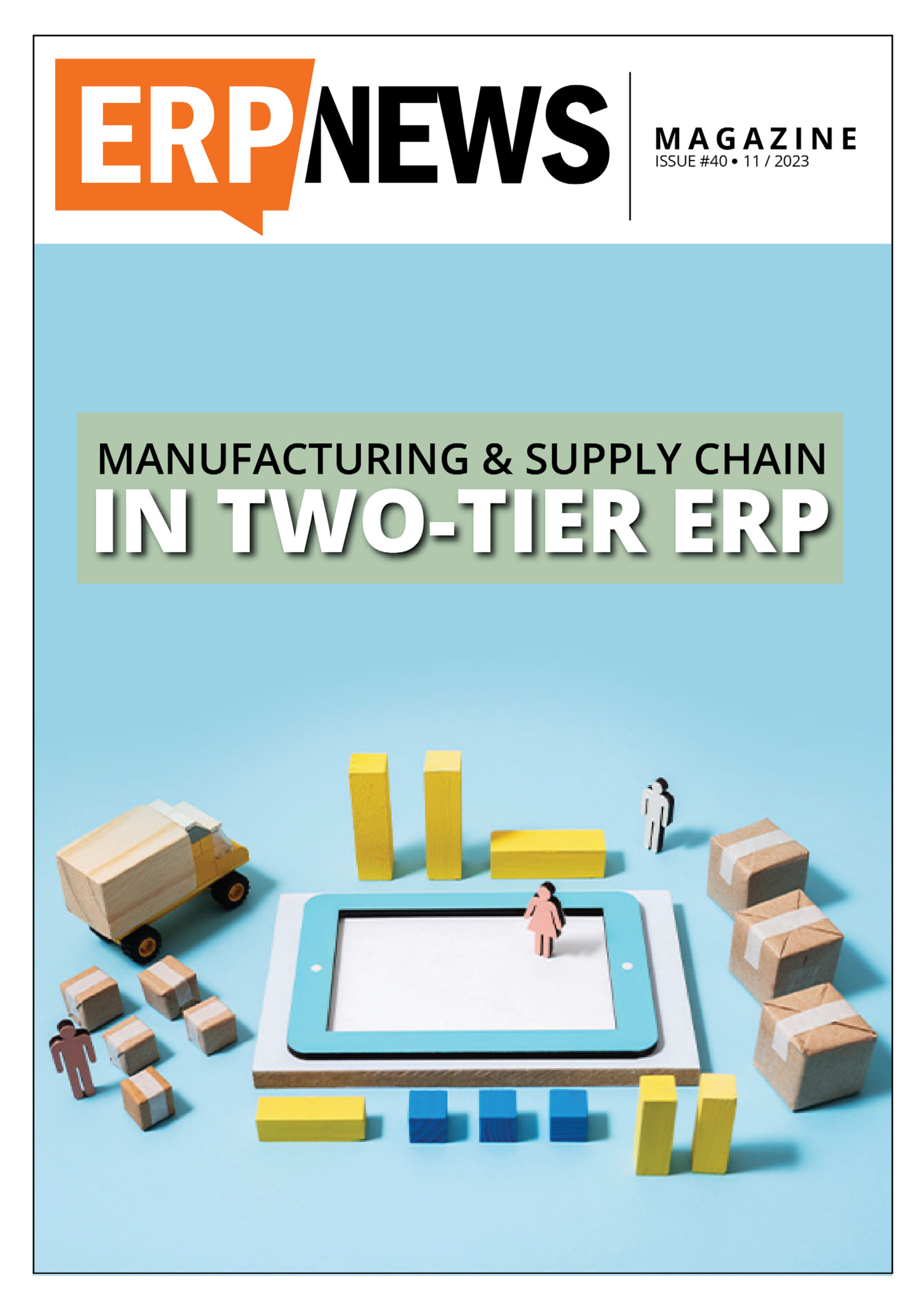
How can manufacturers give local operations the systems they need while maintaining a coherent corporate view? ERP News Magazine Issue 40, November 2023, examines manufacturing and supply chain management through a two-tier ERP strategy. Contributions consider the relationship between central finance and subsidiary operations, the work required to connect data, and the choices involved in modernization. Three interviews add perspectives on responsible AI, manufacturing software and remote work, while customer accounts show different approaches to operational change.
Executive perspectives on AI, manufacturing and work
Kausik Chaudhuri, Chief Innovation Officer at Lemongrass Consulting, argues that AI requires clear objectives, relevant data and domain expertise. His interview examines bias, changing data contexts, testing and human supervision. Rather than applying AI indiscriminately, he recommends selecting tools suited to the task and understanding how their outputs are produced. His perspective links technological opportunity with the practical responsibilities of preparing and governing information.
Paulo de Matos, Chief Product Officer at SYSPRO, discusses SYSPRO 8 2023. Integrated quality management, accounts payable automation, warehouse marshaling, analytics connectors, product catalogs and single sign-on are among the capabilities he describes. He connects these features with manufacturers' demands for quality, speed and visibility, including possible uses of machine and other external data. The interview presents product capabilities and intended business value, rather than a quantified customer-results study.
Sanket Akerkar, Chief Revenue Officer at Acumatica, considers remote and hybrid work as an organizational challenge requiring both technology and clear management practices. Cloud access, shared information, onboarding, performance visibility and collaboration support a more flexible workforce. His discussion also recognizes the differing effects on local economies and the need for explicit policies around communication, working expectations and data protection.
Two-tier ERP: architecture, integration and governance
I-Net Dynamics introduces the relationship between a central ERP and systems tailored to subsidiaries or specialized operations. Precision Solutions Group compares the advantages of local fit with the additional demands of integration, master data, training and vendor management. SAP considers two-tier cloud architecture in mergers, acquisitions and divestitures, where operational separation and corporate oversight must be designed together.
Rootstock's extended consolidation guide moves from mapping existing systems to setting objectives, evaluating infrastructure, cleaning data, testing, training and ongoing support. An embedded Northeast Lantern example illustrates the limitations of spreadsheet-based processes. Pinar Sengul, Editor of ERP News, focuses on manufacturing, inventory, supplier collaboration and reporting benefits. Katie Slimov connects similar operational needs with integration complexity, consistent data and change management.
John Donagher, Managing Partner at Lumenia, explains hub-and-spoke scenarios that balance corporate systems with regional manufacturing and accounting requirements. Sage's whitepaper considers when subsidiaries, acquisitions and differing business models justify a second tier, and what to seek in a supporting solution. Its historical research and cost examples provide background rather than a new November 2023 survey. Across these contributions, two-tier ERP is a design choice requiring coordination, not simply the addition of another application.
Modernization, service and supply chain analysis
Christoph Nagy, CEO of SecurityBridge, outlines SAP vulnerability categories and the importance of patching, access controls and security monitoring. Andrew Kurtz, CEO of Kopis, argues that modernization can reduce fragmented processes and security exposure while supporting growth and customer trust. Mike Ettling, CEO of Unit4, challenges cloud-migration concerns through discussion of updates, support, scalability and integration, with qualitative examples from Magnox and Southampton City Council.
Aptean examines an integrated food-and-beverage technology stack spanning ERP, enterprise asset management and overall equipment effectiveness. Pizza Joe's illustrates cloud ERP, CoreFX Ingredients maintenance management, and Monogram Foods digital production monitoring; the latter reports a ten-point OEE improvement. Andreas Bareid of QAD considers battery technology, regional supply chains and the interaction between established automotive manufacturers and startups. IFS reviews ten ways enterprise service management can support HR, from self-service and workflow to knowledge, service levels and feedback.
Customer stories: reported changes and practical limits
Redmond Inc.'s Acumatica account describes replacing disconnected accounting and custom systems through a phased rollout. Crestwood Associates supported the initial implementations, followed by internal deployments. The narrative moves from the first five businesses to seven, and reports improved inventory visibility and millions saved at Best Vinyl. Development work described as taking 40 hours previously takes four. The story connects those results with process cleanup, integrations and the group's own implementation team, rather than attributing every aspect of growth to software alone.
REHAU Group's Chinese subsidiary combines SAP S/4HANA Cloud, integration and intelligent automation with support from SAP and Delaware. The case reports 50% shorter implementation time and 40% lower total cost of ownership, alongside much faster production-order processing and batch closing. The project is described as a foundation for wider cloud standardization, with automated workflows reducing manual effort.
Pixel Networks uses Odoo to connect its website, commerce, sales, invoicing and subscriptions. The Hong Kong telecommunications provider describes easier access to customer records, automated renewal invoices and more flexible sales-order changes. These are qualitative workflow improvements; the case does not supply a numerical revenue or labor-saving result.
Ultra Tool & Manufacturing extends Plex ERP and MES with Automation and Orchestration to connect plant-floor activity. Its phased machine integration and operator training address production recording, labeling and setup. The account reports US$48,000 in annual savings from recording and label automation, a separate US$80,000 setup-time saving, and 243 annual labor hours saved. The measures are presented separately because the issue does not establish that their scopes are additive.
Boyett Construction builds a Quickbase application to coordinate project information from bidding through closeout. Dashboards, notifications and centralized data support more concurrent work and faster answers across office and field teams. The story describes broader business growth and stronger distributor relationships without establishing a single, isolated software-only growth rate.
Industry developments and product direction
News includes Sage HR integration for Sage 50, Acumatica 2023 R2, NetSuite Text Enhance and Unanet's inventory and project-manufacturing capabilities following the Flowtrac acquisition. Aptean's manufacturing outlook reports survey associations between automation, cloud adoption and performance; those findings are not controlled proof of causation. Rootstock previews its Minneapolis manufacturing event and Signal Chain approach.
Van Oord selects IFS Cloud, Siemens Healthineers selects RISE with SAP, and Devon County Council chooses Unit4 with Embridge Consulting. Their reported selections are distinct from the intended future rollout benefits. Microsoft's Dynamics 365 Field Service review, credited to Safiyyah O'Quinn and co-authored by Caroline Dent of Velrada, considers mobile workflows, remote expertise and mixed reality. Together, the issue frames enterprise transformation around fit, integration, reliable data and the people who put systems to work.
Read Issue 40 Online
The magazine is loaded directly from ERP News servers.