What Are the Top ERP Trends in 2024?
Explore the ERP trends shaping 2024 through five interviews, cloud and AI developments, security guidance, and customer stories across manufacturing, commerce and global operations.
About this issue
Preparing for the next phase of ERP
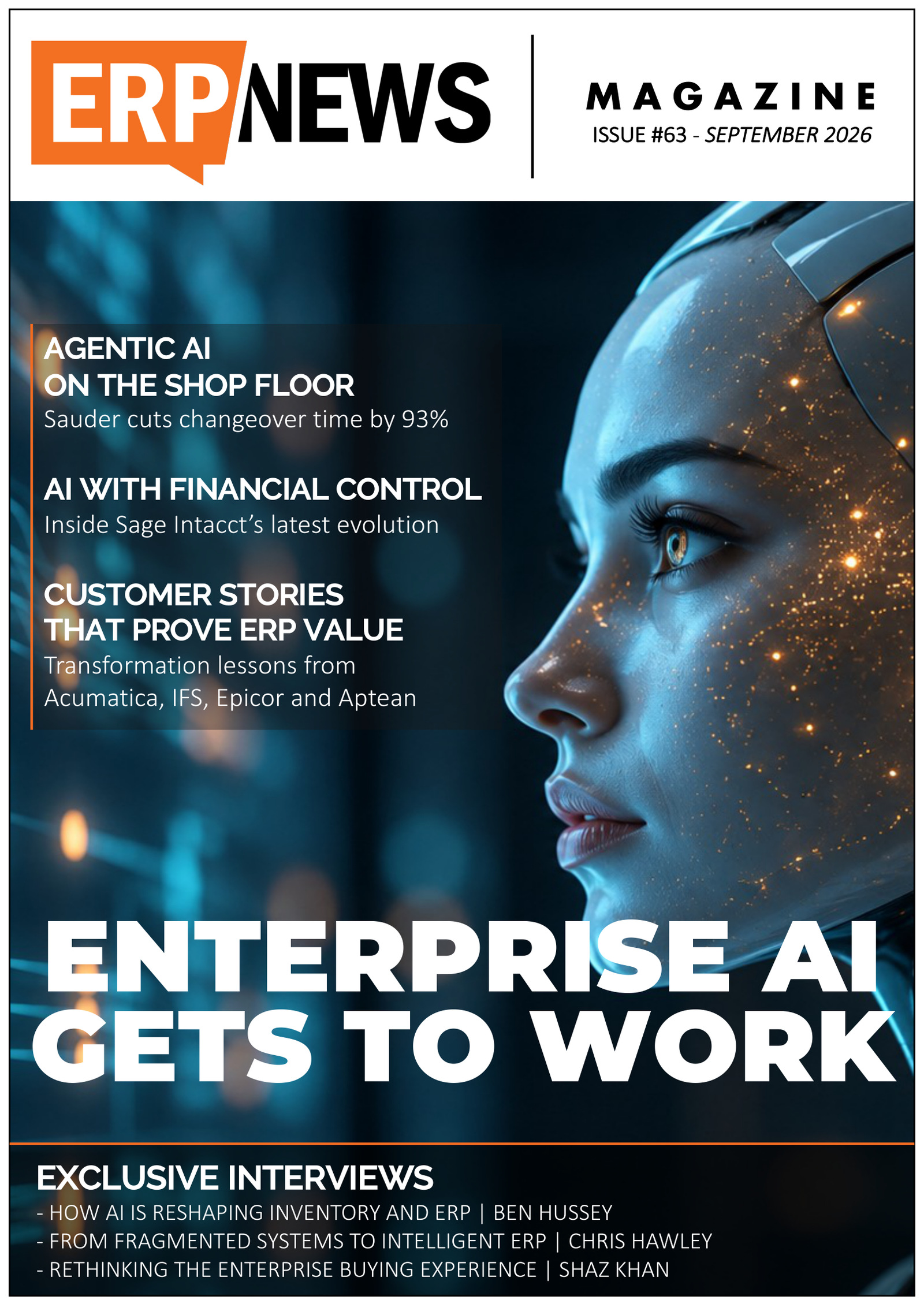
Which ERP developments deserve attention as businesses plan for 2024, and what foundations make them useful? ERP News Magazine Issue 41, December 2023, examines this question through five interviews, contributed analysis, product developments and customer experiences. Cloud platforms, artificial intelligence, industry specialization, security and connected data recur throughout the issue. Rather than treating new technology as a result in itself, the strongest contributions connect it with usable workflows, reliable information and operational priorities.
Five perspectives on ERP strategy
Sükrü Ilker Birakoglu, Senior Director at Logpoint, discusses the Vulnerability Monitoring Analyzer and the challenge of prioritizing SAP security patches. The tool assesses missing corrections and ranks their relevance using system-usage information. Importantly, he distinguishes automated assessment from automated patch implementation, which remains a roadmap item in the interview. His wider outlook connects cloud adoption, application security, user experience and future AI-assisted monitoring.
Alan Doyle, Director of Corporate Systems at Population Services International, explains why PSI selected Unit4 ERPx for its international nonprofit operations. Project and grant management, financial visibility, forecasting and auditable workflows are central requirements. The planned transition addresses fragmented country-office data and delayed reporting, with staff training and change management supporting adoption. These are implementation objectives and expected benefits, rather than a completed-results account.
Craig Halliday, CEO of Unanet, discusses acquiring Flowtrac to extend inventory and project manufacturing capabilities for government contractors. He connects procurement, government-furnished property, compliance and forecasting with an integrated ERP ecosystem. BlueHalo provides an example of consolidating acquired businesses and reducing implementation effort. Halliday's broader argument is that connected tools and ongoing customer support must develop alongside changing project requirements.
Andrew Kurtz, CEO and President of Kopis, considers conversational interfaces, cloud ecosystems and the convergence of configurable software with custom development. He sees low-code tools and AI as ways to bridge that divide, particularly around Microsoft Dynamics 365 Business Central. His interview also emphasizes discovery, user experience, security and industry expertise: technology choices should follow the business problem and the processes that affect financial performance.
Josh Fischer, Director of Product Management, Retail, at Acumatica, explains the integration with Shopify's B2B capabilities. Customer hierarchies, company-level relationships, flexible price lists and connected inventory support a consumer-like purchasing experience for business buyers. The discussion covers the 2023 R2 release and Acumatica Payments, while describing multi-site merchandising improvements as future development rather than already-delivered functionality.
Analysis: foundations before automation
Christine Barnhart, Chief Marketing and Industry Officer at Nulogy, argues that AI and machine learning investments should reflect supply chain digital maturity. Her four-stage framework moves from capturing reliable data through connection and collaboration to cognition. Mike Melzer, VP of Operations and Service at Global Shop Solutions, contrasts fragmented manufacturing processes with integrated scheduling, costing, inventory, finance and quality workflows. John McCurdy's Aptean contribution focuses on fresh produce: bidirectional traceability, quality, grower transactions and inventory management for perishable goods.
IFS examines service life-cycle management as a connected discipline spanning field service, repairs, spare parts, asset management and aftermarket opportunities. Three trend articles offer complementary outlooks: Tranetech discusses cloud, mobile access, usability and connected devices; Olly Lukatski of Priority considers specialization, customization, integration and the broader human experience; Katharina Miller of Yaveon connects AI, IoT, analytics, sustainability, mobility, security and compliance. These are perspectives published ahead of 2024, rather than current market measurements.
Customer experiences and reported outcomes
Coles' recruitment story describes SAP SuccessFactors integrated with Phenom and supported by automation. The retailer reports time-to-fill reduced by six days, time-to-hire by two days and recruitment advertising spending by 50%. The account also explains how mobile applications, candidate matching and scheduling changed the hiring process, while acknowledging the continued need for human judgment in more complex roles.
Superior Trim's Plex feature links smart manufacturing with production recording, machine integration, guided assembly and inspection. The 2023 Transformer Impact Award account reports sales doubling since 2017 and a direct-labor metric falling from 9.0% to 7.8%. These describe the company's broader development; forecast full-year sales growth and anticipated retention gains remain separate from achieved results.
Speck Pumpen's abas ERP case connects production and sales planning with multisite operations and adaptable processes. The company reports delivery times shortened by about half, from roughly three-to-five months to six-to-ten weeks. A product configurator and connected ERP processes also reduce the stated quotation phase from 14 days to 15 minutes. Planned upgrades and machine-data work remain prospective.
Nestlé's SAP story describes a global cloud transformation supporting core systems, HR and customer experience. It reports moving 1,200 terabytes of data, improving system availability to 99.97% and deploying digital assets ten times faster. The account distinguishes completed infrastructure and process improvements from the continuing migration to SAP S/4HANA Cloud, private edition, and consumer-facing pilots.
Jeffree Star Cosmetics and Killer Merch use Acumatica to connect commerce, distribution, inventory and royalty accounting. Supporting more than 80 Shopify stores, Killer Merch reports shipping times reduced from six-to-ten days to one-to-two days and faster access to royalty information. The case shows why shared data matters when product launches produce sudden order surges, without presenting peak order volumes as a daily average.
Dura-Shiloh describes replacing fragmented ERP environments with a standard Plex model across 15 plants. Executive sponsorship, common configuration and plant-level training support repeatable deployment. The account reports less than 1% material variance at one facility's first post-implementation physical inventory; that specific observation should not be generalized to every plant.
ZEISS Group combines SAP Digital Manufacturing and SAP BTP with process validation in a regulated production environment, working with Deloitte and Syntax. The story reports substantial reductions in specified paper-based processes and growth from three to ten parallel rollouts. The broader 29-rollout schedule is a plan, while connected shop-floor and business data provide the foundation for further manufacturing improvement.
Product developments and industry news
News includes Aptean's acquisition of 3T Logistics & Technology Group, Sage's AI-generated Member Masterclass, the November 2023 IFS Cloud release, Rootstock's World Tour Chicago plans, and Odoo's partnership with Ricoh Hong Kong. NetSuite's restaurant coverage adds accounts from Hofman Hospitality Group, Lettuce Entertain You and Union Square Hospitality Group, focusing on financial visibility and reporting.
SAP and the Mercedes-AMG PETRONAS F1 Team announce a partnership starting in 2024, with cloud, cost-cap planning and operational insights as intended areas of work. Microsoft's Copilot review separates available capabilities from previews and future releases. The Odoo 17 review covers redesigned interfaces, industry configurations, ChatGPT-assisted writing, commerce, manufacturing and finance. Together, these contributions place the next phase of ERP at the intersection of practical integration, trustworthy data and people able to use it.
Read Issue 41 Online
The magazine is loaded directly from ERP News servers.