Blockchain Integration in ERP: Transforming Security and Transparency
Explore blockchain's role in ERP security and supply-chain transparency, with Protera CEO Mike BeDell, SAP BTP guidance, manufacturing insights and customer stories.
About this issue
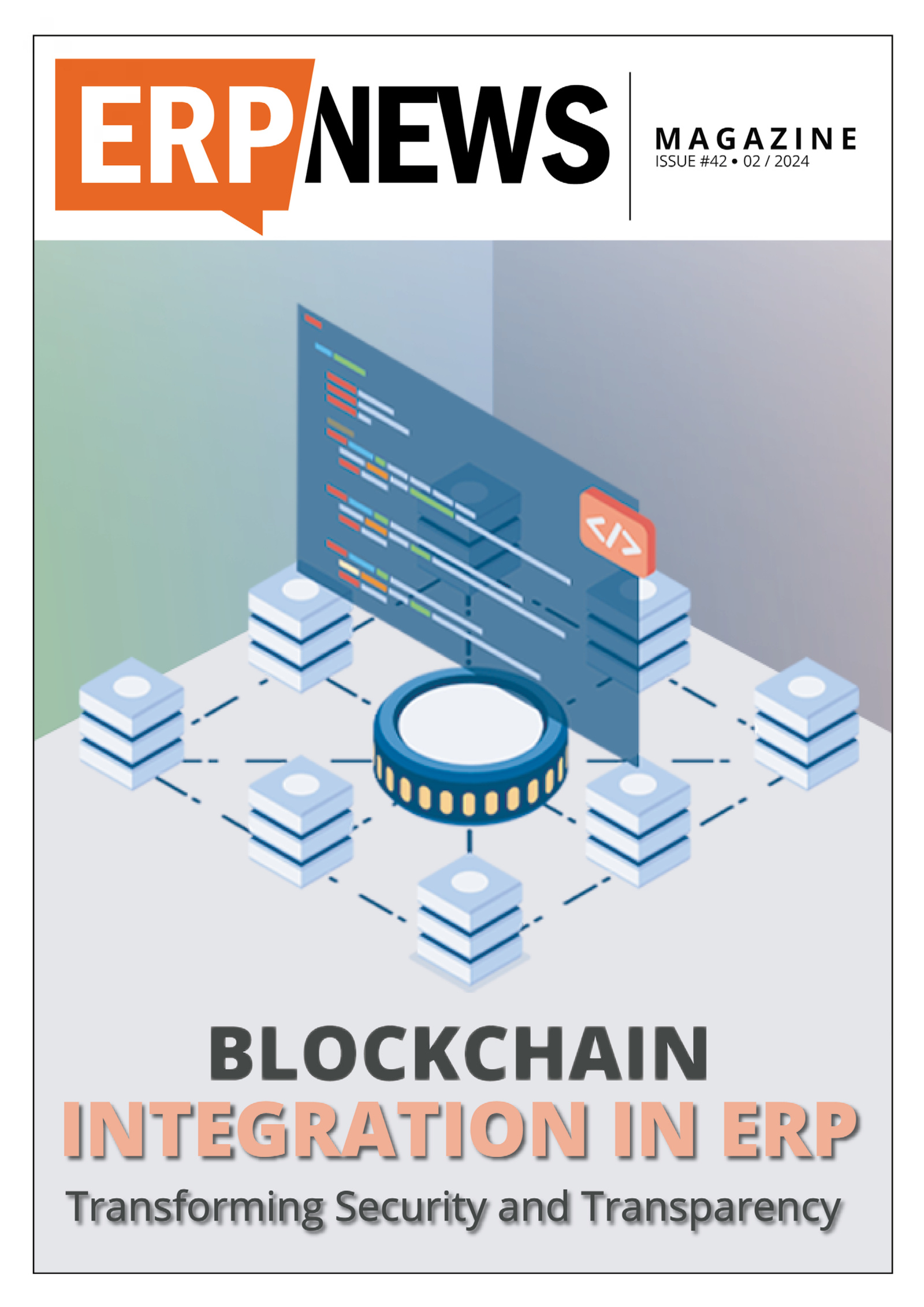
Blockchain Integration in ERP: Transforming Security and Transparency
How can organizations extend trust beyond their own enterprise systems when transactions, products and decisions cross company boundaries? The February 2024 edition of ERP News Magazine examines blockchain integration in ERP through the connected questions of security, transparency and shared data. Alongside its central theme, Issue 42 considers cloud modernization, manufacturing performance, logistics, generative AI in finance and workforce development. Its articles describe possible applications of emerging technology, while customer accounts provide a separate view of operational changes already reported by users.
Executive Perspectives and SAP Security
Mike BeDell, CEO of Protera, discusses the company's service authorizations for SAP S/4HANA Cloud, private edition, SAP S/4HANA on-premise and SAP Business Technology Platform. His argument extends beyond migrating an SAP application: enterprises need to consider surrounding workloads, IT operating practices, security and financial governance. BeDell describes Protera's role as a long-term transformation partner and discusses hybrid cloud, continuous optimization and AI-assisted detection and remediation. He also emphasizes that moving to the cloud alone will not resolve every business problem.
Christoph Nagy, CEO of SecurityBridge, examines security responsibilities in SAP BTP environments. His article focuses on authentication, permissions, identity management, data exchange, audit logs and integration architecture. A clean core still requires customers to understand and monitor their own security obligations. Separate SecurityBridge news reports recognition of its research laboratory by SAP's Security Response Team and the appointment of Joris van de Vis as research director.
Blockchain, Shared Records and Business Processes
BoldBrix connects blockchain with supply chain visibility, trusted data and automation, including the data foundations used by AI applications. Ultra Consultants considers the implications for manufacturing and distribution: shared transaction records, smart contracts, cross-company collaboration and integration choices. Al Reyami Technologies explains distributed ledgers and their proposed relationship with existing ERP capabilities, including identity verification and automated transactions. These contributions outline potential benefits rather than documenting a single completed blockchain ERP implementation.
Supply chain consultant Abhishek Pareek explores blockchain-enabled pricing in Oracle Cloud. He describes smart contracts, tokenization and possible connections to Oracle Order Management, while noting that implementation complexity and costs must be evaluated against the use case. Oodles Blockchain widens the discussion with a review of Polygon applications in decentralized finance, digital assets, governance, logistics, education and identity. Future Market Insights contributes a decentralized finance market outlook; its growth rates and 2034 valuation are forecasts published in the issue, rather than achieved results.
Manufacturing, Logistics, Finance and Sustainability
Chris Pinaire of Global Shop Solutions presents seven connected practices for manufacturers seeking reliable quality and on-time delivery. Production planning, inventory, quality control, supply chain visibility, finance automation, analytics and collaboration form the proposed operational blueprint. Aptean examines five transportation management challenges, covering route planning, delivery execution, customer service, home delivery and performance measurement. Its examples include reported improvements at Wren Kitchens and BSW Timber, plus an unnamed pharmaceutical customer.
Matthew Medley, Global Industry Director for Aerospace and Defense at IFS, offers predictions for 2024 around asset readiness, industrial capacity, autonomous drones and cybersecurity. These are contemporary expectations from the February 2024 issue. Luis Trunk de Flores considers SAP's sustainability and responsible AI agenda in the context of COP28 and Davos. David Appel and Eric Sleeth of Sage examine possible uses of generative AI in SaaS finance, including subscription metrics, forecasting, board reporting and revenue recognition; the article is an analysis of capabilities and opportunities rather than a measured customer implementation.
Customer Stories and Reported Outcomes
ZEISS Group describes adopting SAP Digital Manufacturing and SAP BTP to connect business systems with shop-floor processes in a regulated manufacturing environment. Working with Deloitte and Syntax, the group developed a validated rollout approach following a proof of concept at Carl Zeiss Meditec. The story reports near-total removal of specified paper records and printed instruction verification in the initial rollout, and an increase from three to ten parallel rollouts. Its plan for 29 rollouts is a forward-looking deployment schedule.
Lacher Großküchen GmbH replaced an older system with abas ERP to integrate finance, purchasing, sales, projects and service. The case describes electronic invoice processing, connected applications and more transparent project information. It reports that information previously taking up to 12 hours to collect for invoicing became centrally available, alongside higher finance productivity and improved liquidity visibility. These results relate to the company's broader process redesign and implementation.
Hunkemöller's SAP announcement reports a move to SAP S/4HANA Cloud Private Edition with Google Cloud through RISE with SAP, including a reported 48-hour migration. Fashion-specific capabilities and more personalized customer experiences are presented as subsequent steps and expected opportunities, rather than completed outcomes.
Oracle NetSuite's retail coverage gives three customer examples. Feetures combines ERP, Shopify and other data for product and financial analysis. Hudson&Canal reports reducing weekly landed-cost and accrual analysis from four hours to ten minutes. Thread describes using consolidated data and machine learning to support forecasting and inventory planning. Each illustrates a distinct use of NetSuite Analytics Warehouse.
Redmond Inc.'s Acumatica story describes fragmented accounting, inventory and reporting across a diversified group. Its opening results panel reports inventory savings, improved visibility and a reduction in development time from 40 hours to four. The published extract concentrates on the preceding business challenges and contains inconsistent entity counts: five companies in the headline and seven businesses in the results panel. Those counts should not be silently reconciled.
ABC-Groep replaced fragmented annual engagement questionnaires with Unit4 Talent Management. Connected engagement, performance and learning modules support regular feedback, career conversations and development. The consultancy reports steadily improving engagement scores without providing a numerical improvement rate.
Industry Developments
News coverage includes Lumenia Consulting's ERP HEADtoHEAD event, Acumatica Summit 2024 announcements, Epicor's selection of Agiloft for contract lifecycle management, and 3i Infotech's reported inclusion in a Gartner student information systems market guide. Rootstock introduces QuickStart for mid-sized manufacturers, while Sage, The BOSS Network and Swoop announce training and mentoring for Black women entrepreneurs in Atlanta. Together, the issue frames ERP innovation as a combination of trustworthy data, practical integration, operating discipline and attention to the people using enterprise systems.
Read Issue 42 Online
The magazine is loaded directly from ERP News servers.