AI & Machine Learning in ERP
Explore intelligent automation, predictive insights, enterprise AI readiness, and the customer experiences shaping the next generation of ERP.
About this issue
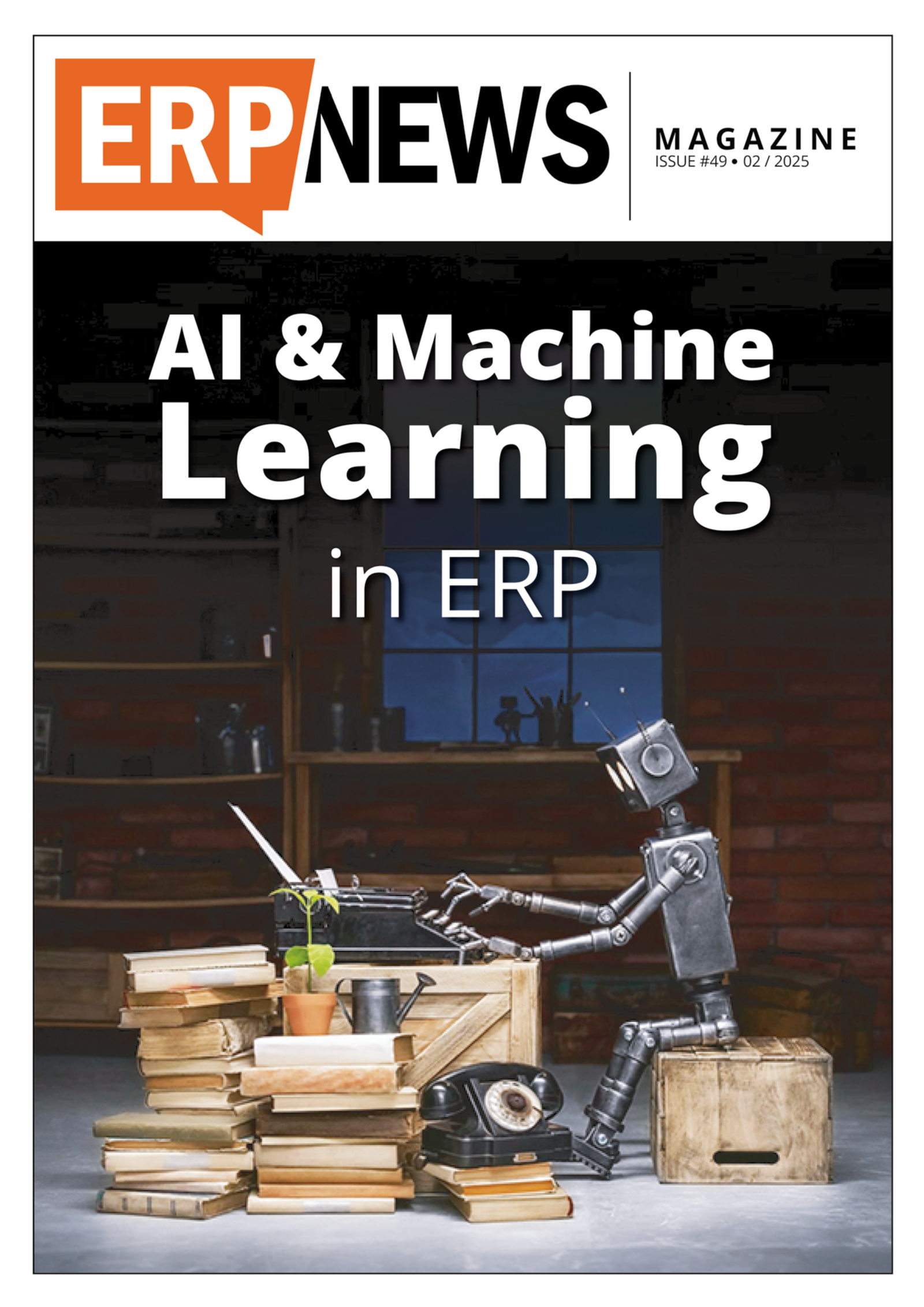
AI and Machine Learning in ERP: Building Intelligent Operations
What does it take to turn AI-enabled ERP from a technology ambition into useful business capability? ERP News Magazine Issue 49, February 2025, explores automation, predictive insights, enterprise readiness, manufacturing, accounting, and security. Its contributions connect intelligent software with the information, skills, and processes needed to use it effectively.
The issue brings together an executive interview, practical guidance, research, product announcements, and customer experiences. Its recurring message is that AI value depends on a dependable operational foundation: accessible data, clearly defined needs, trained people, and governance that can keep pace with change.
Executive Perspective: Customer-Driven ERP Innovation
Jeremy Larsen, Vice President of Product Management at Acumatica, discusses the 2024 R2 release and the customer feedback behind its development. He describes anomaly detection, reporting and analytics, a personalized user experience, and deeper Amazon and Shopify integrations. Construction billing, manufacturing estimates, receiving verification, and professional-services requirements demonstrate how industry needs shape the roadmap.
Larsen emphasizes balancing advanced capability with accessibility. His longer-term perspective anticipates more assistive, intuitive ERP interactions as AI and machine learning evolve. Reported early-adopter feedback is qualitative rather than a measured productivity benchmark.
Accounting, Inventory, and Manufacturing
Rebeca Bichachi, Product Marketing Specialist at Oracle NetSuite, examines AI in accounting through machine learning, deep learning, natural-language processing, and generative AI. Forecasting, invoice capture, reconciliation, reporting, and anomaly detection can shift accountants toward analysis and advice. The article also considers costs, skills, integration, regulation, and the need for clean information, with NetSuite Bill Capture and Analytics Warehouse as product examples.
Brady Stevens, Senior Consultant at Global Shop Solutions, offers ten steps for physical inventory. Planning, labeling, controlled movement, mobile counting, spot checks, variance review, and validated updates place process discipline before automation. Priority's manufacturing outlook broadens the discussion to IIoT, digital twins, robotics, sustainability, workforce development, connected supply chains, cloud infrastructure, and cybersecurity.
CIS examines AI applications across ERP, supply chains, and finance, recommending focused use cases, compatible tools, staged pilots, training, and performance monitoring. Absolute ERP and GO-Globe explore related opportunities in predictive analytics, routine-task automation, customer service, and real-time reporting. Accurate Systems presents prospective ERPNext AI integrations; its forward-looking discussion is not treated as confirmation that every described feature has shipped.
Enterprise Readiness, Learning, and Security
SAP contributors Walter Sun, Sean Kask, and Jonathan von Rueden set out five AI themes: agentic systems, business context for models, adoption, conversational user experience, and regulation. Their analysis distinguishes future multi-agent workflows from simpler tools and emphasizes meaningful enterprise information and responsible development.
Infosys organizes enterprise AI readiness around strategy, governance, talent, data, and technology. Its research-based Q&A discusses gaps between experimentation and organization-wide capability, while retaining limitations on industry and regional comparisons. Unit4, drawing on a sponsored IDC InfoBrief, considers progression from assistants to advisors and agents, emphasizing trust, employee involvement, and continuous skills development.
Elena Abilova, Education Project Manager at Acumatica, describes community feedback and Open University training as resources for effective ERP use. Barry Snow, Technical Account Manager at SecurityBridge, examines SAP Solution Manager's connections with other SAP systems and the risks that can follow a compromise. His contribution is an introduction to the problem and platform scope, with a later part promised for protection measures.
Finance Transformation and Industry Developments
David Appel, Sage's Head of the SaaS Vertical, describes OneStream's use of Sage Intacct alongside its own finance platform to support scale and public-company readiness. The account reports financial close reduced from more than fifteen days to five, with billing, consolidation, and integration improvements. These results concern a combined technology and process environment, rather than Sage Intacct acting alone.
Lumenia's ERP HEADtoHEAD announcement explains a structured selection event with scripted demonstrations. News items introduce Clarus Partners Advisors' AkuCalc, Rootstock research on manufacturers' planned AI spending, and Sage's IDC accounts-receivable automation recognition. SAP presents retail public-cloud ERP and planned commerce innovations at NRF 2025, while Infosys and Tennis Australia discuss Australian Open AI experiences.
Epicor introduces Prism conversational ERP and vertical agents, including an early adopter's expected benefits. Acumatica highlights Mid-States Companies, IOC Construction, and Happy Valley as organizations moving beyond basic accounting software. These announcements distinguish deployed systems, research findings, and future ambitions.
Customer Stories: Connecting Technology with Outcomes
Active8 Managed Technologies implemented ECI e-automate, Printanista, MobileTech, and KnowledgeSync to connect its managed-print operations and support diversification into adjacent services. The story describes a shared business dashboard, remote device information, less manual work, and improved contract visibility. Its efficiency and profitability claims remain primarily qualitative.
Novaria Group selected Epicor Kinetic on the government cloud to replace fragmented systems across acquired aerospace and defense businesses. Eight companies had migrated in the source account, supporting shared services, standardized procedures, actual costing, and greater supplier visibility. Broader rollout and further analytics capabilities remained in progress or under evaluation; the case reports improved profitability and audit efficiency without a precise attributable ROI calculation.
Q-PAC Systems connected its QUIPS fan-system configurator with Acumatica Manufacturing Edition after outgrowing spreadsheets and basic accounting. Automated manufacturing requirements, bills of materials, inventory visibility, and reporting gave teams faster access to project costs and order status. Daily reports became available immediately and monthly reports within two or three days of month-end. Further warehouse changes and automated customer notifications were still planned.
AAFMAA modernized legacy applications with Software AG and MetroStar Systems, using Adabas, Natural, NaturalONE, and EntireX to preserve existing investments while enabling web and mobile services. The historical account reports operating-cost reductions above 50%, separate processing-cost savings, and investment recovery faster than expected. Its older project milestones reinforce a broader lesson across the issue: sustainable transformation can combine new capabilities with systems and expertise already in place.
Read Issue 49 Online
The magazine is loaded directly from ERP News servers.