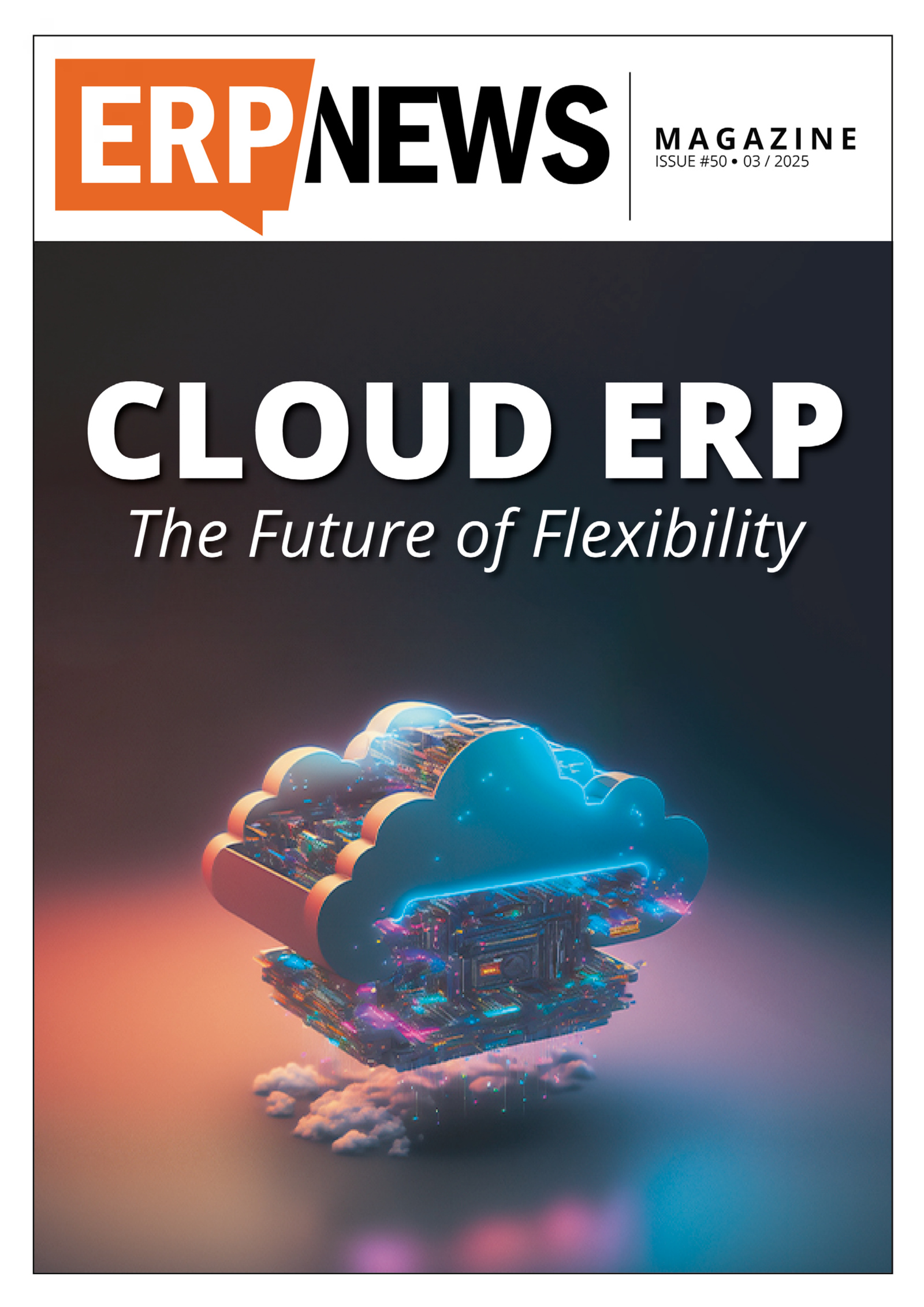
Cloud ERP: The Future of Flexibility
Explore cloud ERP adoption, intelligent manufacturing, analytics, and the customer experiences shaping more flexible enterprise operations.
About this issue
Cloud ERP: The Future of Flexibility
How can organizations gain flexibility from cloud ERP while keeping data, processes, and people aligned? ERP News Magazine Issue 50, March 2025, examines that question through manufacturing research, cloud architecture, analytics, AI, security, workforce strategy, and customer experience. Its theme extends beyond moving applications online to the operational changes that make connected systems useful.
The issue combines an executive interview with practical articles, industry announcements, and four customer stories. Together, they show how cloud platforms can support responsive operations while demanding clear priorities, reliable information, implementation expertise, and continuing governance.
Manufacturing Perspectives and Connected Processes
Kelly Kucera, Senior Vice President of Global Marketing at SYSPRO, discusses research into smart manufacturing. She highlights a gap between enthusiasm for AI and IIoT and actual implementation, alongside difficulties obtaining real-time data. Her recommendation is to start with executive support and identifiable business problems, demonstrate value through focused improvements, and build on a flexible ERP foundation. Embedded analytics, workforce development, and partner expertise feature throughout the conversation.
Adam Grabowski, Director of Marketing at Global Shop Solutions, presents ten inventory disciplines for smaller manufacturers. Documented responsibilities, consistent transactions, regular counts, obsolete-stock review, supplier evaluation, automation, and training connect inventory accuracy with operational control. Barry Spielman, Director of Product Marketing at Priority, outlines manufacturing ERP capabilities including MRP, product data, engineering changes, quality, traceability, and inventory coordination.
Lauren O'Hara, ERP Product Marketing Manager for Construction at Acumatica, explains integrations with JobPlanner and STACK. Their combined scope connects estimating and preconstruction with project management and ERP workflows. Lumenia's ERP HEADtoHEAD announcement also addresses selection, describing a structured event where demonstrations follow common scripts so organizations can compare solutions and implementation considerations.
Data, Cloud Architecture, and Customer Support
Pamela Pierce, Product Marketing Director at Oracle NetSuite, challenges misconceptions about cloud data warehouses. She distinguishes data preparation and storage from business-intelligence presentation, discusses security and commercial differences, and explains how NetSuite Analytics Warehouse combines enterprise information with analytics. The contribution argues that useful, consistent data matters more than simply accumulating a large volume.
Infosys provides a broader cloud-computing guide covering private, public, hybrid, multicloud, and polycloud approaches, together with infrastructure, platform, software, and function services. It examines migration goals, costs, skills, security, provider choices, and monitoring. The emphasis is matching architecture to business requirements rather than assuming one deployment model fits every organization.
SAP contributors Stefan Steinle and Thomas Saueressig discuss customer-support transformation through AI-assisted recommendations, ticket routing, proactive detection, and knowledge creation. Their account retains a central role for human empathy and expertise. Vivek Iyer, Atlassian's Head of Product for IT Operations, explains the announced transition of Opsgenie capabilities into Jira Service Management and Compass, connecting incident management with development and operations teams.
Intelligent Workflows, People, and Governance
Stacey McIntosh, Sage Advice UK's editor, sets out five HR priorities: responsible AI, skills, meaningful employee experience, change leadership, and inclusion. The article treats manager capability and employee trust as foundations for technology adoption.
Accurate Systems explores adaptive ERP workflows that respond to operational data, with integration, security, and training as implementation considerations. Rupesh Chotai, Director at PwC United Kingdom, examines agentic AI for Oracle Fusion Cloud, advocating readiness assessment, valuable use cases, targeted pilots, and ongoing optimization.
Sophie Graham, Chief Sustainability Officer at IFS, discusses the European Commission's proposed Omnibus changes and the continuing value of sustainability information. Her contribution is presented as March 2025 proposal-stage commentary. Tenable's Juan Perez, Managing Editor for Content Marketing, surveys open-source security, AI-related ransomware developments, tool integration, responsible-AI readiness, and other threat research. These articles place governance alongside flexibility, rather than treating cloud adoption as sufficient protection by itself.
Industry Announcements and Research
The news section covers an agreement for increased Apax investment in ECI alongside Leonard Green & Partners and GIC, Sage Copilot's first-year milestone, and Infosys's open-source Responsible AI Toolkit. Rootstock reports TEC recognition; Unit4 shares sponsored IDC research on human-centered AI adoption in finance; and MarketsandMarkets presents a cloud ERP growth forecast.
Veeva introduces aggregated HCP access data through CRM Pulse. Multiview reports healthcare ERP recognition from KLAS, GMB adopts Unanet ERP and CRM, and St. Petersburg selects Tyler Technologies solutions for government services. SAP reports its Strategic Challenger position in Fosway's learning-systems analysis, while Capgemini discusses its Forrester SAP-services recognition. The issue distinguishes announcements, analyst assessments, forecasts, and customer deployments.
Customer Stories: Operational Flexibility in Practice
Hackensack Meridian Health uses Infor Cloverleaf and HL7 FHIR to connect disparate healthcare information. The case reports more than 65,000 hours saved annually, faster appointment booking, and shorter waiting-room times. These are source-reported operational outcomes; the article does not supply a detailed methodology or prove a general clinical benefit for every deployment.
Orb Interiors implemented Priority ERP with ERPiQ to address manual work and growth constraints. Its narrative reports tripled output, doubled margins, and 99.2% on-time delivery in its B2B business. The headline's statement about doubling capacity and the body’s reported results are retained as distinct source claims rather than merged into a single benchmark.
Exotic Woods adopted ECI Spruce to manage specialized lumber inventory, varied units of measure, purchasing, and linked sales documents. General Manager Mike DeBoer describes approximately $100,000 released from dead inventory, about $2,000 in annual paper savings, and at least ten hours of labor time saved each week. Inventory capital and recurring expense savings are different benefits, and the source does not specify the dollar currency.
City of Yarra worked with Lánluas on TechnologyOne workflows and online business-application portals. Reported results include an estimated 10% efficiency improvement, 70% fewer application-related emails, and 87% of applications lodged online. Annual savings above $500,000 remain expected. Across the issue, these experiences reinforce a practical conclusion: flexibility comes from well-designed workflows, accessible information, and sustained organizational capability.
Read Issue 50 Online
The magazine is loaded directly from ERP News servers.