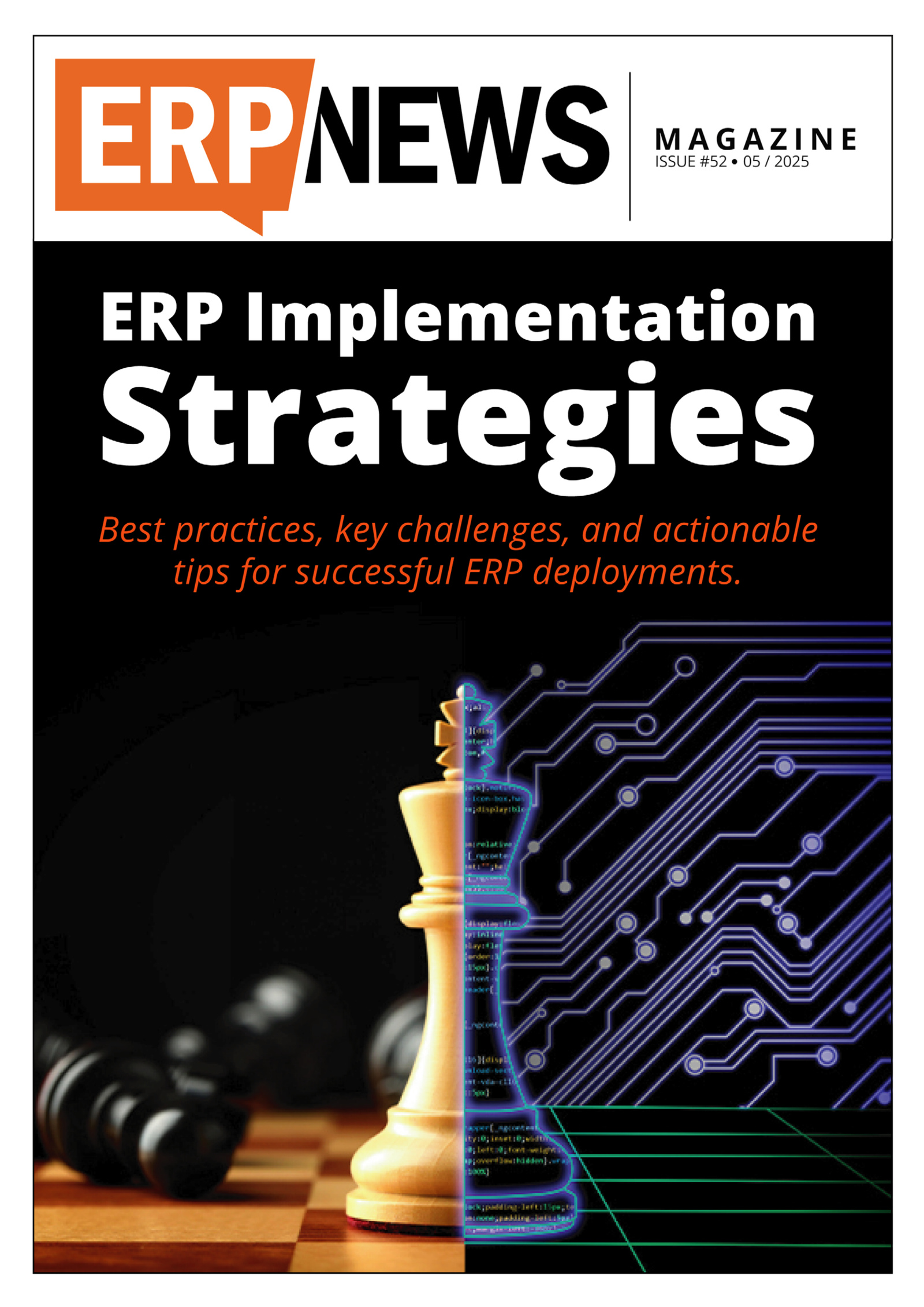
ERP Implementation Strategies
Best practices, key challenges, and actionable tips for successful ERP deployments.
About this issue
ERP Implementation Strategies: Turning Plans into Lasting Change
What separates a successful ERP deployment from a costly technology exercise? ERP News Magazine Issue 52, May 2025, examines the decisions, people, and operating disciplines that shape implementation. Its coverage connects project governance, data migration, employee adoption, manufacturing processes, financial management, and emerging AI capabilities with experience from customers and technology providers.
The issue treats go-live as one milestone within a longer transformation. Contributors consider how organizations define business needs, select delivery approaches, prepare employees, and sustain improvement once systems are operating. Customer accounts show why implementation choices must remain connected to everyday work and measurable business priorities.
Planning, Governance, and User Adoption
Jarrett R. Smith, Operations Consultant at Global Shop Solutions, follows the engineer-to-order lifecycle from customer request to performance review. His ten essentials connect document control, accurate quotations, project kickoff, engineering approval, materials planning, flexible production schedules, and real-time cost monitoring. For manufacturers producing customer-specific equipment, the argument is that ERP must coordinate design information and financial visibility throughout the order, rather than simply record completed transactions.
Apty's implementation guide addresses stakeholder communication, standardization, data management, change, project leadership, training, testing, phased rollout, and post-implementation review. It compares big-bang, phased, parallel, and hybrid approaches and explains how digital adoption platforms can provide contextual guidance inside applications. Method selection depends on business complexity, available resources, and tolerance for disruption.
Amarjeet Singh Bawa, Vice President of Professional Services & Support at BatchMaster Software, emphasizes a realistic implementation plan, an appropriate project team, structured change management, clean data, selective customization, solution fit, and effective testing. His manufacturing perspective makes employee readiness and accurate migration central delivery responsibilities.
Plante Moran adds a governance and commercial perspective. Its ten rollout recommendations include contractual protections, executive sponsorship, subject-matter expertise, requirements traceability, interface inventories, chart-of-accounts design, contingency funding, and independent oversight. Together, these articles encourage organizations to resource the business side of implementation as carefully as technical configuration.
Finance, Supply Chains, and Operational Improvement
Prasad Joshi, Senior Manager at Baker Tilly US, maps recurring finance challenges to Oracle Cloud EPM capabilities. Illustrative scenarios cover consolidation, reconciliation, close coordination, planning, cost allocation, and metadata governance. The article explains how centralized workflows and consistent information can address fragmented financial processes; these scenarios are not presented here as verified named-customer results.
In an interview conducted by Acumatica Marketing Communications Specialist Anna Elizabeth Gant, Kelly Squizzero, Senior Product Manager for Distribution, discusses supply chain optimization. She connects distribution requirements planning, warehouse mobility, ecommerce integration, and practical AI with transparent collaboration and continuous monitoring. Her software-selection criteria include industry fit, usability, integration, scalability, vendor support, and total cost of ownership.
NTT DATA Business Solutions extends the operational discussion to manufacturing transformation. Its framework combines unified ERP data, smart technologies, and profitable personalization. Connected planning and production information provide the foundation for automation and more flexible responses to customer requirements.
AI, Quality Management, and Support
Matt Kempson, SVP Group Commercial at IFS, introduces the IFS.ai Activation Pass as a way to pilot embedded AI use cases and assess value before broader deployment. The article distinguishes this packaged approach from Nexus Black co-innovation. Its introductory offer and availability statements belong to the issue's 2025 publication context.
Brian Brooks, Director of Product Management at QAD, describes the Spring 2025 EQMS release. Responsibility reassignment, progress indicators, record mentions, and medical-device documentation features address workflow continuity, visibility, collaboration, and quality management.
Stefan Steinle, SAP's Executive Vice President and Global Head of Customer Support & Cloud Lifecycle Management, explores six approaches to proactive support: real-time monitoring, proactive resolution, predictive analytics, customer journey mapping, in-app assistance, and a proactive team culture. The contribution connects SAP Cloud ALM, Signavio, and contextual support with an emphasis on preventing issues before they interrupt users.
Industry Developments and Customer Announcements
The news section includes GTSE's use of Avalara and BigCommerce for US tax compliance, Atigro's ERP augmentation toolkit for construction and engineering management, VFS Global's adoption plans for SAP cloud technologies, and Rootstock's Gold Stevie Award. Sage and AWS discuss domain-specific accounting AI, while Kinaxis reports BayWa r.e. Solar Trade's implementation of Maestro for supply chain orchestration.
Unit4 introduces Ava as a conversational interface to ERPx and Microsoft Teams, with broader autonomous capabilities forming part of its direction. An ISG research report examines SAP migration economics, industry expertise, clean-core approaches, and ecosystem services. Capgemini's perpetual KYC sandbox provides a controlled environment for testing event-based compliance processes. These announcements describe provider claims and deployment intentions within their original publication context.
Customer Stories: Value after Implementation
Abergeldie Complex Infrastructure uses IFS Applications 10 and Success Services to supplement a small internal IT team, improve dashboards, and advance operational projects. CFO David Wood highlights staged delivery, training, and a standard system core. Analysis identified duplicate project-reporting work costing approximately AUD 187,000 a month; a pilot targeted that opportunity, with projected contract-life savings of AUD 12–14 million. These figures represent potential savings, while improved access to expertise and mobile approvals are described as existing benefits.
Lyft selected Oracle Fusion Cloud applications and related data and analytics services to replace fragmented finance systems, working with Deloitte. Implementing the first Accounting Hub elements in four months reportedly reduced revenue-ledger close time by more than half. Further reductions in the full financial close remained expectations. The underlying implementation concerns Oracle Fusion Cloud rather than NetSuite.
Resonac Holdings Corporation uses SAP SuccessFactors to support recruitment, learning, performance, succession, and a more collaborative culture. Its account reports 93.8% of mandatory positions filled and 90 talent pools. Employee Central, Compensation, and expanded analytics remained implementation priorities. The story reinforces the issue's central lesson: sustainable ERP value depends on aligning technology, information, and the people who use it.
Read Issue 52 Online
The magazine is loaded directly from ERP News servers.