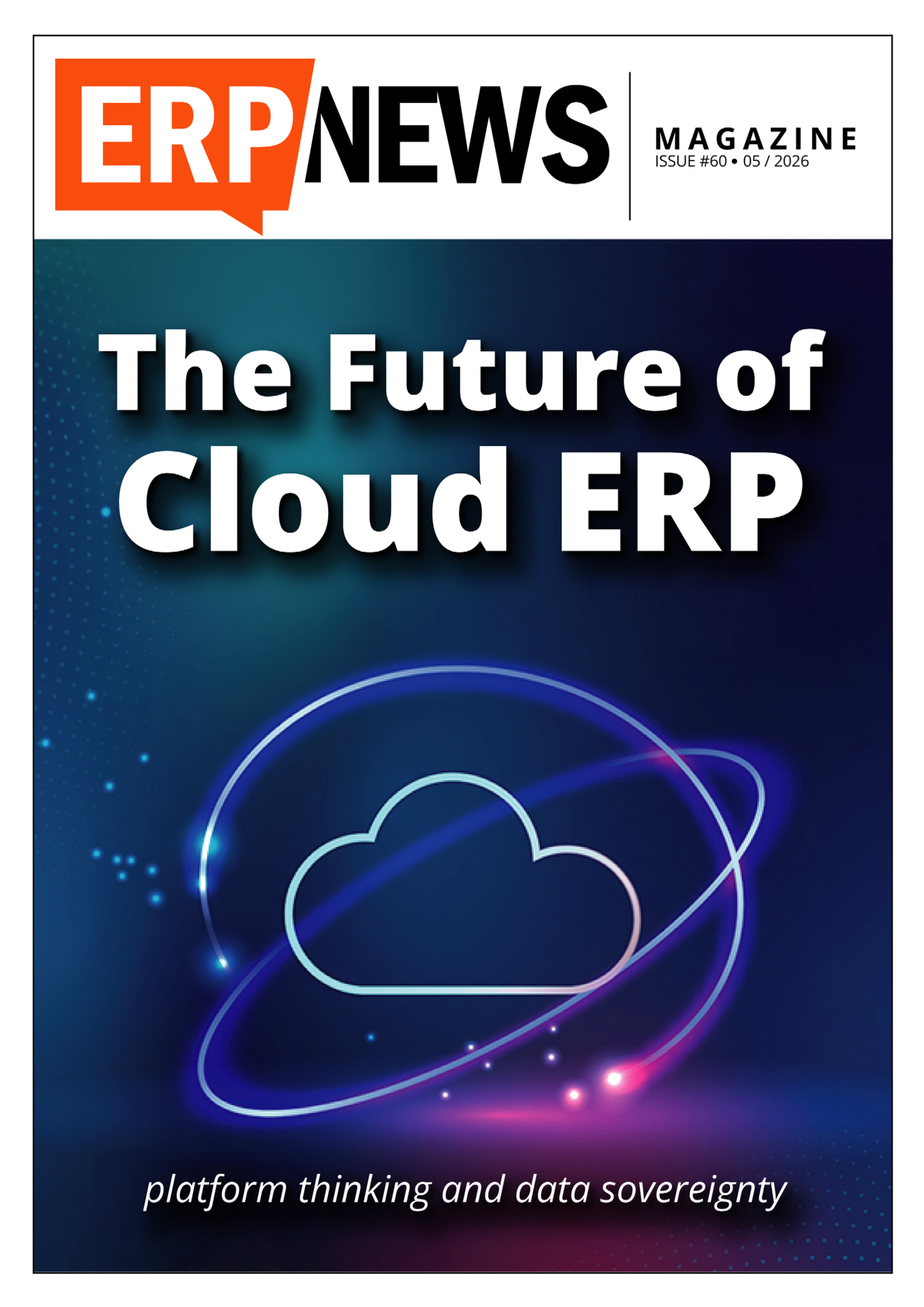
The Future of Cloud ERP
Platform Thinking and Data Sovereignty
About this issue
The Future of Cloud ERP: Platform Thinking and Data Sovereignty
What should cloud ERP enable beyond moving enterprise systems to a different hosting environment? ERP News Magazine Issue 60, May 2026, explores that question through executive interviews, industry contributions, product announcements and customer transformation stories. Its central theme connects platform thinking with data sovereignty: organizations need connected workflows and embedded intelligence while retaining control, transparency and accountability over enterprise data.
The issue examines how ERP can support execution across finance, manufacturing, construction and customer service. It also considers the foundations that make these ambitions practical, including reliable operational data, industry expertise, implementation discipline and sustained user adoption.
Executive Perspectives
Jon Pollock, Chief Product Officer at Acumatica, explains how the company’s 2026 R1 release positions AI within everyday financial and operational workflows. He discusses applications across manufacturing, distribution, retail and construction, from inventory planning to project forecasting. His argument connects AI adoption to a unified data foundation, incremental deployment and clear oversight, rather than treating intelligence as a separate destination for users.
Holly Oberbroeckling, Director of Channel Sales at Epicor, examines the expanding responsibilities of ERP partners. Industry specialization, repeatable delivery methods, integration skills and customer success increasingly shape the relationship beyond implementation. She describes an ecosystem in which vendor platforms and partner expertise work together to support adoption, extensions and ongoing modernization.
Akshay Mahajan, Executive Vice President of AEC at Unanet, focuses on the disconnect between winning construction work and delivering it profitably. Discussing the Unanet-Xpedeon partnership, he explains why pipeline assumptions, proposal commitments, project costs and resource availability need to remain connected. Integrated CRM and ERP can improve forecasting and preserve information through the project lifecycle; the interview discusses these benefits without presenting a quantified customer benchmark.
Joanne Harrison, Sales Director and Owner at Optimum, places training and change management at the center of ERP transformation. She advocates role-specific, process-led learning, centrally governed materials with controlled localization, and ongoing support after go-live. Digital learning and AI can reinforce knowledge, but complex processes still require expert instruction and human facilitation.
Dan Miller, EVP, Financials & ERP Division at Sage, distinguishes task automation from agents that progress work within finance workflows. He describes supervised autonomy, human approval for consequential actions and auditable records of recommendations and execution. His perspective links the evolution of finance toward exception management and judgment with the need to preserve accountability.
Analysis and Industry Developments
Sameer Verma, Vice President and Chief Product Officer of Microsoft Dynamics 365 AI ERP, explores agentic supply chain operations. His contribution connects planning, procurement, production and delivery through governed access to operational systems. Examples involving Coca-Cola Beverages Africa, Farmlands Cooperative and LC Waikiki illustrate the discussion of connected planning and inventory visibility.
Global Shop Solutions’ contribution examines paperless travelers, barcode transactions, controlled work instructions and digital quality records. It offers a phased approach to shop-floor traceability, emphasizing practical measures such as time spent locating work in progress and errors avoided through scanning.
Stephen Dombroski of QAD discusses the execution gap in food, beverage and consumer products manufacturing. ChampionAI’s procurement, sourcing and sales agents are illustrated through ingredient delays, supplier changes and complex quotation requests. These scenarios explain potential workflow improvements; they are not identified as measured results from named customers.
Jaime Lesmes Carabal of Odoo describes its Mid-Market Corporate approach to larger implementations, covering discovery, gap analysis, phased delivery and the Odoo.sh deployment environment. Magali Amiel, Director and Global Industry Lead for Manufacturing at CGI, addresses resilience through connected signals, scenario planning, supplier risk monitoring and human decision ownership. Ellen Cox of Epicor explains how Prism Developer for Application Studio supports natural-language customization generation with review and validation before changes are merged.
News and Platform Announcements
The news section covers Salesforce Agentforce Operations and its approach to coordinating back-office work across systems; Premier Construction Software’s partnership with Quickly for integrated early payments; and Hensel Phelps’s SAP Cloud ERP Private transformation with Syntax and its AI CodeGenie Suite. Oracle NetSuite introduces SuiteCloud Agent Skills for AI-assisted development, distinguishing initially available skills from those announced as forthcoming.
Rootstock Ready combines a focused ERP scope, templates, training and a fixed-fee implementation model. The announcement projects up to three times faster time-to-value based on prior experience and early analysis; this is a forecast, not a demonstrated customer result. Performance figures in the Salesforce announcement likewise remain vendor-reported claims.
Customer Stories
Rauma Marine Constructions selects IFS Cloud to connect project management, procurement, production, logistics and financial control across complex shipbuilding programs. Improved forecasting and shorter vessel build times are objectives of the deployment, rather than quantified outcomes already achieved.
Venture Engineering replaces QuickBooks, spreadsheets and paper-based manufacturing processes with Acumatica Manufacturing Edition, supported by Cedar Bay Partners. The story reports visibility across more than 20,000 parts and over 50 projects, improved quoting and labor tracking, restricted customer access to project information, and the reassignment of eight employees previously managing project spreadsheets.
Chiesi’s SAP customer story details its move to SAP S/4HANA Cloud Private Edition through RISE with SAP, supported by IBM and SAP services. Reported results include a nine-month migration and a 75% reduction in data migration downtime, from 40 hours to 10. Further logistics, master data and AI initiatives remain part of its continuing transformation roadmap.
Finnair uses Salesforce Agentforce alongside Service Cloud and connected travel data to support passenger enquiries and help employees find relevant information. The story reports an 80% enquiry resolution rate and a 25% reduction in employee onboarding time. Booking actions such as automated refunds are described as future capabilities.
TAL Building Centers consolidates fragmented systems with Epicor BisTrack in the cloud. Its customer story reports a 100-basis-point gross margin improvement, a 15% inventory reduction and a 20% reduction in back-office headcount, alongside more consistent dispatch and delivery processes.
Across these perspectives, the issue presents cloud ERP as a foundation for connected operations and continuous change. Its practical test is whether organizations can translate shared data into timely action while sustaining governance, user confidence and operational control.
Read Issue 60 Online
The magazine is loaded directly from ERP News servers.
Featured Companies