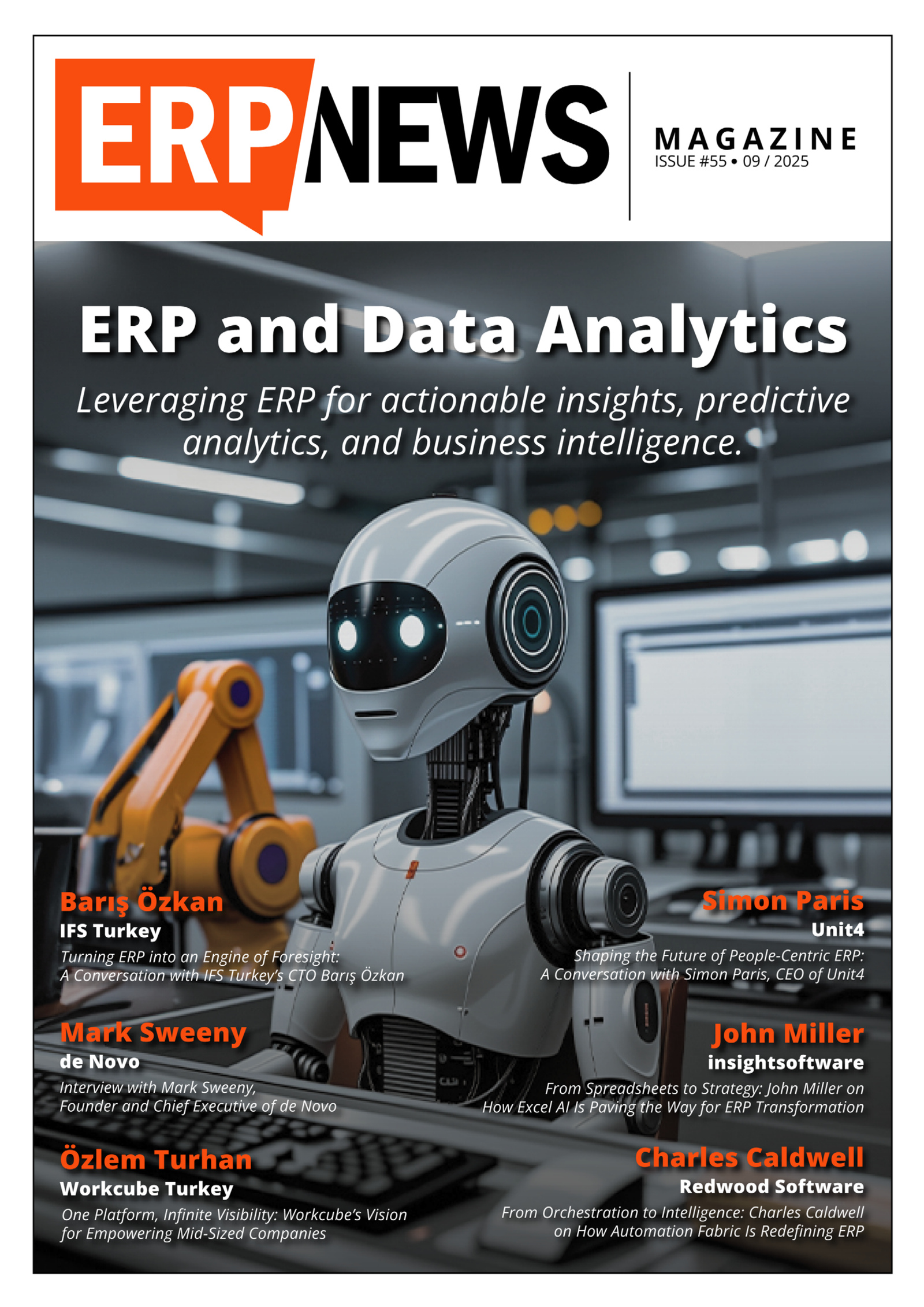
ERP and Data Analytics
Leveraging ERP for actionable insights, predictive analytics, and business intelligence. Explore how connected data, embedded AI, and automation support better decisions.
About this issue
ERP and Data Analytics: Turning Information into Action
How can enterprise data help organizations anticipate change rather than simply explain what has already happened? ERP News Magazine Issue 55, September 2025, examines the connection between ERP, predictive analytics, business intelligence, and automation. Through six interviews, practical articles, industry announcements, and customer stories, the issue explores how information becomes useful within the workflows where decisions are made.
Its central theme is that analytics depends on more than dashboards. Reliable data, integration, governance, user confidence, and operational context determine whether AI can support meaningful action. The issue considers these foundations across industrial operations, finance, public services, and growing businesses modernizing their systems.
Executive Perspectives: Industrial Intelligence and Unified Visibility
Barış Özkan, Chief Technology Officer at IFS Turkey, discusses Industrial AI as intelligence embedded in sector-specific processes. His interview connects predictive maintenance, scenario modeling, and operational visibility with data integrity and governance. He describes Saloni Mobilya's use of IFS to centralize production, sales, inventory, and logistics information, with reported improvements in traceability and coordination. The conversation also distinguishes investment plans and future agentic capabilities from established customer experience.
Mark Sweeny, Founder and Chief Executive of de Novo Solutions, explains the company's approach to industry cloud solutions built on Oracle Cloud and ServiceNow. His Value as a Service model assesses innovation, adoption, optimization, and efficiency, while Odyssea supports sector-focused transformation. The interview links sustained growth with customer relationships, workforce development, and delivery discipline. Planned expansion into AI-enabled shared services is presented as a strategic direction.
Özlem Turhan, Managing Partner at Workcube Turkey, explores how a unified ERP, CRM, finance, supply chain, and HR platform can improve cross-functional decisions. She discusses validation, role-based access, forecasting, and scenario simulation. Levent Kimya provides a customer example of replacing fragmented, paper-based processes with integrated operations and barcode-supported warehouse workflows. Further prescriptive analytics, natural-language access, and ESG capabilities are discussed as development directions.
Simon Paris, CEO of Unit4, sets out a focused strategy for people-centric organizations, including professional services, nonprofits, public bodies, and higher education. He connects cloud ERP, customer success, and generative AI with the relationship between people, projects, and finance. His discussion of ambient ERP and conversational access emphasizes meeting users within familiar working environments while maintaining human oversight and governance.
Finance AI and Automation across the Enterprise
John Miller, Vice President of Product Management for ERP Reporting and BI at insightsoftware, explains why Excel can offer finance teams a practical starting point for AI adoption. Formula generation and variance-report narratives provide opportunities to test usefulness before extending successful approaches into ERP. His priority is reporting from source data, validating outputs, and building confidence through incremental adoption rather than relying on disconnected exports.
Charles Caldwell, Senior Vice President of Product Management at Redwood Software, examines automation fabric as a layer connecting ERP with other enterprise systems. He discusses event-driven orchestration, workload visibility, migration support, and the infrastructure required for AI-enabled operations. His message is that process connectivity and data readiness should precede ambitious autonomous workflows, particularly where legacy systems and operational handoffs remain fragmented.
Practical Analysis: ROI, Embedded AI, and SME Readiness
Wilfried Juncker of Odoo presents five approaches to ERP return on investment: simpler implementation, integrated core functions, measurable performance, automated invoicing, and regular reassessment. His article treats value realization as a continuing process shaped by adoption and evolving business needs.
Pavel Ramanouski, Head of SAP BI and EPM practice at ACBaltica, examines embedded AI in cloud ERP through forecasting, natural-language queries, planning, and scenario simulation. The article also addresses phased availability, licensing, data quality, and implementation support, encouraging readers to evaluate specific use cases rather than assume every announced capability is universally available.
Paul Timms, Director of IT System Integrators Ltd, examines the practical barriers SMEs face with AI: uncertain costs, limited skills, legacy systems, inconsistent data, and concerns about trust. He recommends focused initial projects such as invoice capture or customer order processing. HansaWorld's Standard ERP appears as an example of integrating AI into operational software rather than treating it as a separate experiment.
Industry Developments: Finance Innovation, Integration, and Market Change
The news section follows Auditoria.AI's SmartResearch initiative, funding momentum, and enterprise partnerships, alongside Sage Intacct's updates to close, reconciliation, procurement, payments, and sustainability tools. SecurityBridge's report on a critical SAP vulnerability highlights the importance of patch management, while Jentic's appointment of Erik Wilde connects enterprise agents with API standards and governance.
Further coverage examines Forterro's acquisition of Inology, Evergreen's Pine Services Group adding Equation Technologies, and Unit4 research into Canadian public-sector modernization. These items connect product innovation with the wider requirements for interoperable systems, specialist expertise, and reliable access to information. Announced availability, growth objectives, and anticipated acquisition benefits remain distinct from demonstrated customer outcomes.
Customer Stories: Protecting Integrations and Connecting Operations
Autotrader's Embridge Consulting story focuses on reducing integration risk ahead of migration to Unit4 Cloud. Embridge's LEO managed integration service replaces a legacy database connection with a cloud-compatible approach built on Microsoft Azure. Intelligent batching supports demanding billing traffic while reducing internal management effort. The protected integration is an achieved step; completion of the wider ERP cloud migration is still anticipated in the source account.
Target Darts uses SAP Business One and Codeless Platforms' BPA Platform to connect commerce, warehouse, and operational data across its growing international business. The case describes automated Magento order handling, synchronization, invoicing, and integration with Produmex WMS. It reports fewer manual tasks and improved visibility, while Sana Commerce and further intercompany workflows remain in progress or planned. Despite the headline's reference to significant ROI, the article provides no quantified financial return.
Together, these perspectives present ERP analytics as a practical discipline of connecting trustworthy information with the people and processes that use it. The issue offers readers a basis for evaluating where AI, integration, and automation can improve decisions, and what organizational foundations they require.
Read Issue 55 Online
The magazine is loaded directly from ERP News servers.